The National Capital Region (NCR) is one of India’s fastest-growing urban and industrial regions, comprising Delhi and surrounding districts of Haryana, Uttar Pradesh, and Rajasthan. Large-scale residential townships, industrial parks, logistics hubs, metro rail expansion, commercial developments, airports, and expressways have significantly increased the demand for high-quality Road Construction Services in Delhi NCR. According to the Ministry of Road Transport and Highways (MoRTH), India continues to expand and modernise its road network through national highway upgrades, urban mobility projects, and economic corridor development, while the Delhi NCR region remains one of the country’s most strategically important transportation hubs.
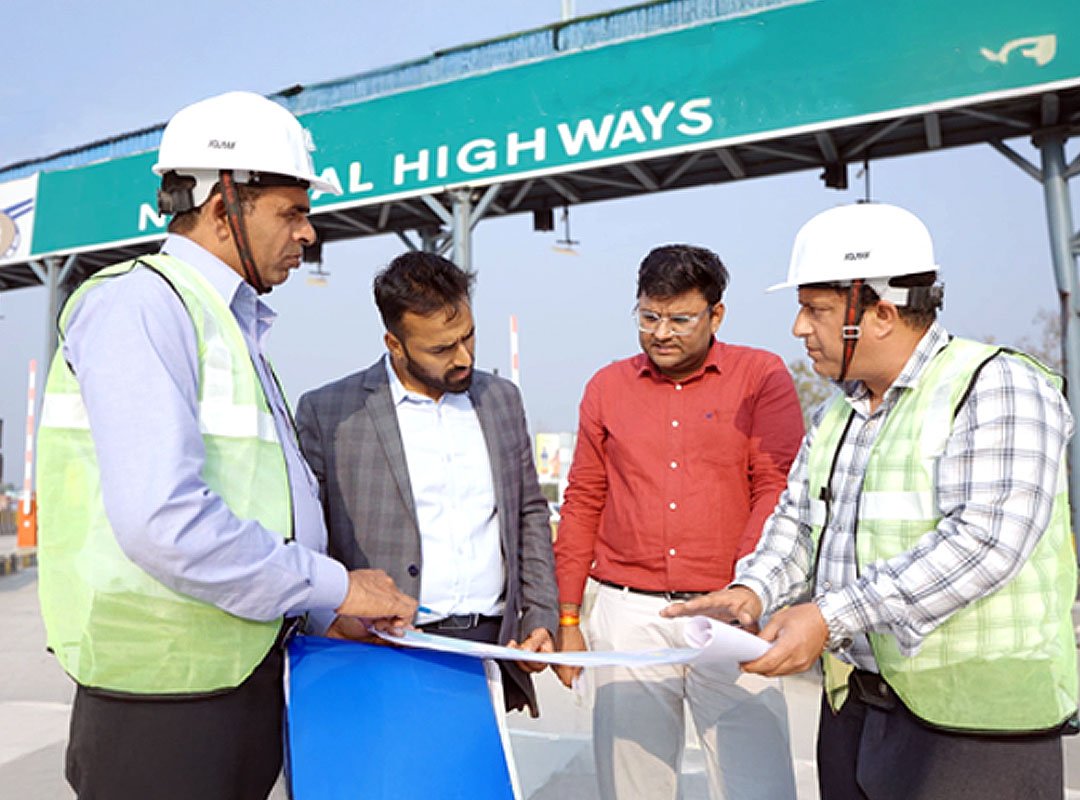
Delivering road infrastructure in Delhi NCR is considerably more challenging than in many other parts of India. High traffic density, mixed land use, variable soil conditions, stringent environmental regulations, limited working space, and continuous urban expansion require contractors to combine engineering expertise with careful planning and strict quality control. Every stage—from pavement design and material selection to construction methodology and testing—must comply with established technical standards to ensure long-term durability, safety, and operational performance.
Professional Road Construction Services in Delhi NCR are therefore built on much more than construction capability alone. Successful projects require compliance with national specifications, modern engineering practices, efficient resource management, quality assurance, and disciplined execution strategies. Companies such as Pawan Highways India Pvt. Ltd. (PHIPL) adopt these engineering principles to deliver reliable road infrastructure that supports economic growth, improves connectivity, and meets the evolving transportation needs of the region.
1. Road Construction Services in Delhi NCR Must Address Diverse Infrastructure Requirements
Unlike projects focused solely on highways, Road Construction Services in Delhi NCR encompass a wide variety of infrastructure requirements, including national highways, urban arterial roads, industrial access roads, township roads, internal circulation networks, service roads, logistics park infrastructure, commercial development roads, airport approach roads, and connector roads linking expressways with urban centres. Each project category has different traffic characteristics, pavement requirements, drainage needs, geometric design standards, and service life expectations. Engineering solutions must therefore be customised according to projected traffic volume, axle loading, surrounding land use, and future development plans rather than relying on standardised construction approaches.
2. Compliance with IRC, MoRTH, and BIS Standards Forms the Foundation of Quality Construction
Every professionally executed Road Construction Service in Delhi NCR is governed by well-established technical standards developed by the Indian Roads Congress (IRC), the Ministry of Road Transport and Highways (MoRTH), and the Bureau of Indian Standards (BIS). These standards specify requirements for pavement design, earthwork, subgrade preparation, drainage, aggregate quality, bituminous works, concrete construction, material testing, safety provisions, and quality control procedures. Compliance ensures that roads achieve the required structural strength, durability, riding quality, and safety performance while maintaining consistency across projects executed by different contractors throughout the country.
3. Pavement Design Must Be Based on Scientific Traffic and Soil Analysis
Pavement design represents one of the most critical engineering decisions in any road project because it directly influences long-term structural performance. Professional Road Construction Services in Delhi NCR begin with detailed geotechnical investigations that evaluate soil characteristics, California Bearing Ratio (CBR), groundwater conditions, drainage behaviour, and anticipated traffic loading. Engineers use these inputs to determine pavement thickness, layer composition, and suitable construction materials capable of withstanding projected axle loads throughout the design life of the road. Scientific pavement design reduces premature failures such as rutting, cracking, settlement, and surface deformation while improving maintenance efficiency over the infrastructure lifecycle.
4. Material Selection Plays a Critical Role in Long-Term Road Performance
The durability of any road depends significantly on the quality and suitability of construction materials used throughout the pavement structure. Professional Road Construction Services in Delhi NCR follow strict material specifications for aggregates, bitumen, cement, granular sub-base, wet mix macadam, and stabilised layers to ensure consistent structural performance under varying traffic and environmental conditions. High-quality crushed aggregates provide adequate strength and resistance to abrasion, while the selection of appropriate viscosity-grade (VG) bitumen is based on climatic conditions and traffic intensity. Modern road projects also increasingly utilise geotextiles, geogrids, fly ash, reclaimed asphalt pavement (RAP), and other sustainable construction materials wherever technically feasible to improve pavement performance, optimise resource utilisation, and reduce environmental impact without compromising engineering standards.
5. Effective Drainage Engineering Is Essential for Road Longevity
Water is widely recognised as one of the most significant factors contributing to pavement deterioration. Consequently, professional Road Construction Services in Delhi NCR place considerable emphasis on designing efficient drainage systems capable of preventing water accumulation within the pavement structure. Proper camber, cross slopes, longitudinal gradients, side drains, median drains, stormwater channels, and cross-drainage structures ensure rapid removal of surface runoff during monsoon conditions. Effective drainage also protects the subgrade from moisture infiltration, reduces erosion, prevents pothole formation, minimises pavement weakening, and significantly extends the operational life of road infrastructure. Well-designed drainage systems therefore contribute as much to long-term pavement performance as the structural pavement layers themselves.
6. Environmental Compliance Has Become an Integral Part of Road Construction
Road construction projects in Delhi NCR are subject to stringent environmental regulations aimed at reducing pollution and promoting sustainable construction practices. Professional Road Construction Services in Delhi NCR implement comprehensive environmental management measures that include dust suppression through regular water sprinkling, controlled transportation of construction materials, proper disposal and recycling of construction and demolition waste, emission control for construction equipment, noise mitigation near sensitive zones, and protection of nearby water bodies and green areas. Contractors are also expected to comply with guidelines issued by environmental authorities and adopt resource-efficient construction methods wherever possible. Integrating environmental compliance into project execution not only fulfils regulatory requirements but also supports sustainable urban development and responsible infrastructure growth.
7. Comprehensive Testing and Quality Control Ensure Long-Term Reliability
Quality assurance is a continuous process that extends throughout every stage of road construction rather than being limited to final project inspection. Professional Road Construction Services in Delhi NCR implement systematic testing programmes covering soil compaction, aggregate gradation, moisture content, California Bearing Ratio (CBR), density of embankment and pavement layers, bitumen content, asphalt mix properties, concrete strength, and pavement thickness. Field tests are complemented by laboratory evaluations to verify compliance with IRC, MoRTH, and BIS specifications before subsequent construction activities begin. Continuous monitoring enables engineers to identify deviations at an early stage, maintain construction consistency, reduce the likelihood of premature pavement failures, and ensure that the completed infrastructure delivers the required structural performance throughout its intended service life.
8. Modern Construction Equipment Improves Productivity and Construction Accuracy
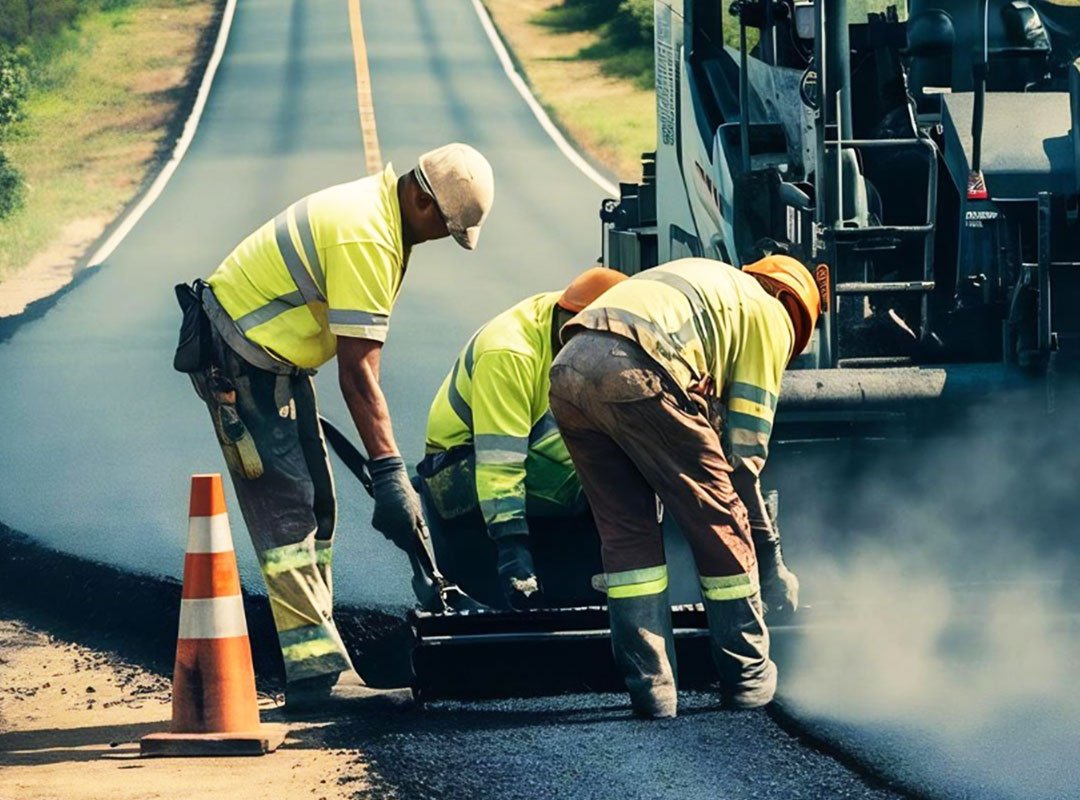
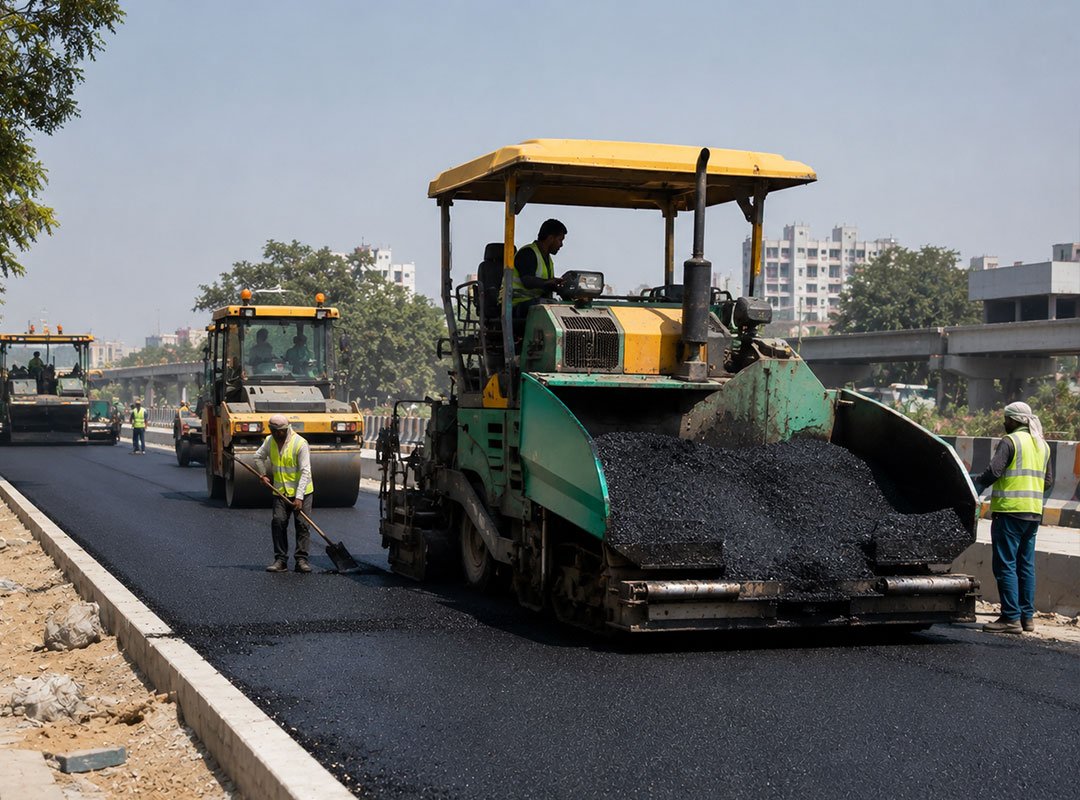
Mechanisation has significantly improved the efficiency, precision, and consistency of modern road construction. Today, Road Construction Services in Delhi NCR rely on advanced equipment such as sensor-controlled asphalt pavers, motor graders, vibratory soil compactors, tandem rollers, pneumatic tyre rollers, milling machines, cold recyclers, concrete batching plants, wet mix plants, and asphalt batch mix plants to execute projects according to specified engineering tolerances. Automated controls help maintain uniform pavement thickness, accurate gradients, proper compaction, and consistent material distribution, reducing human error while improving construction quality. The use of specialised machinery also enables contractors to complete large-scale infrastructure projects within demanding schedules without compromising engineering standards or operational safety.
9. Efficient Execution Strategies Drive Timely Project Delivery
Successful road construction depends not only on engineering design but also on disciplined execution planning. Professional Road Construction Services in Delhi NCR adopt structured construction methodologies that optimise resource allocation, construction sequencing, equipment deployment, workforce planning, procurement scheduling, and material logistics to maintain continuous project progress. Given the scale and complexity of infrastructure development across the NCR, effective execution strategies minimise idle resources, reduce delays caused by material shortages or equipment downtime, improve coordination between various construction activities, and maintain productivity throughout the project lifecycle. A well-planned execution framework ultimately enables contractors to deliver projects within contractual timelines while maintaining consistent quality across all stages of construction.
10. Long-Term Pavement Performance Is the True Measure of Construction Quality
The success of a road project is ultimately determined by how effectively it performs over its design life rather than how quickly it is completed. Professional Road Construction Services in Delhi NCR therefore focus on achieving durable pavement performance characterised by structural stability, smooth riding quality, resistance to rutting and fatigue cracking, effective drainage, and reduced maintenance requirements. Continuous monitoring, periodic condition assessments, and timely maintenance interventions help preserve pavement integrity and maximise infrastructure value for road users and project owners alike. Contractors that prioritise long-term engineering performance instead of short-term construction targets contribute to safer transportation networks, lower lifecycle maintenance demands, and more sustainable infrastructure development.
The growing infrastructure requirements of the National Capital Region demand road construction solutions that combine sound engineering principles with strict quality standards and disciplined execution practices. From scientific pavement design and compliance with IRC, MoRTH, and BIS specifications to material selection, drainage engineering, environmental management, mechanised construction, and rigorous quality control, every aspect of Road Construction Services in Delhi NCR plays a vital role in determining the durability, safety, and operational performance of completed infrastructure.
As urban expansion, industrial development, and regional connectivity continue to accelerate across Delhi NCR, the importance of professionally executed road infrastructure will only increase. Companies such as Pawan Highways India Pvt. Ltd. (PHIPL) continue to support this growth by delivering reliable Road Construction Services in Delhi NCR through engineering expertise, modern construction practices, adherence to national standards, and a commitment to building durable road networks that serve communities, businesses, and the nation’s long-term infrastructure objectives.