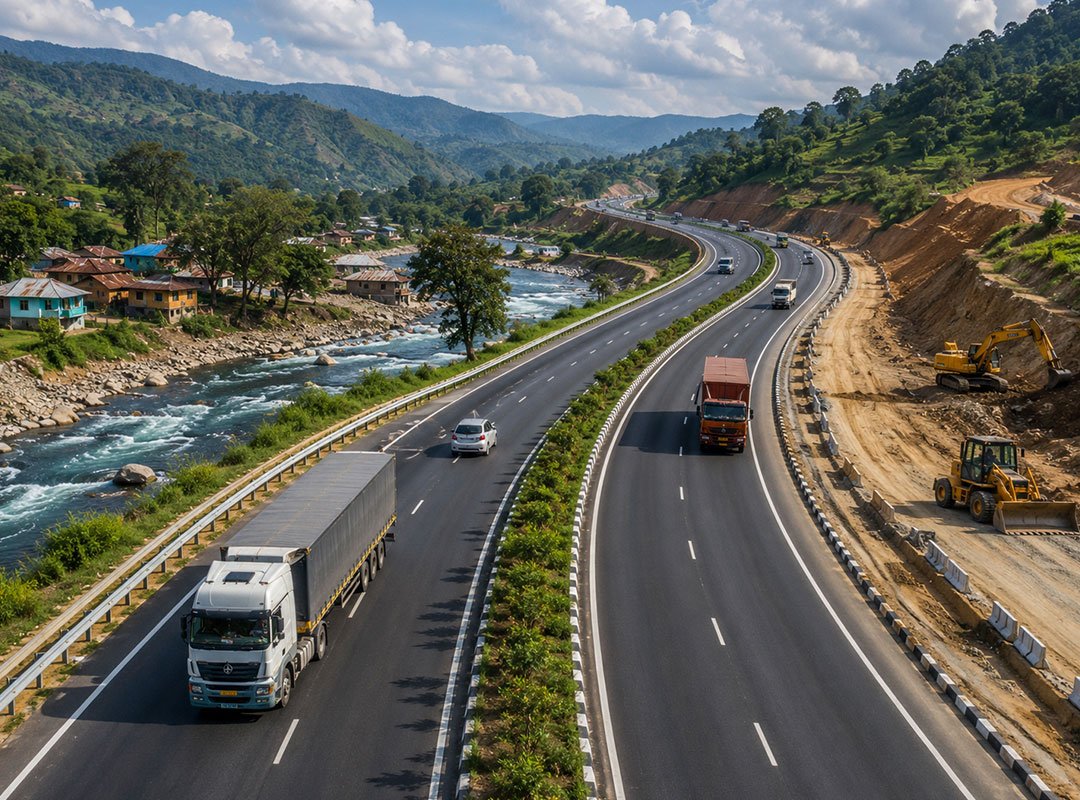

A highway may be designed around pavement layers, bridges, interchanges and drainage structures, but much of its structural performance begins beneath all of them. The soil supporting the pavement and embankment determines how loads are transferred into the ground, how much settlement can occur, how moisture affects strength, and whether the designed pavement can perform as intended. For a Highway Construction Company in India, understanding soil is therefore not simply a geotechnical requirement. It is one of the foundations of highway engineering.
Indian highway standards treat the subgrade as a distinct engineering component rather than simply another layer of earthwork. MoRTH’s specifications and IRC-based highway manuals require the material used for subgrade to satisfy the design California Bearing Ratio (CBR) at the specified density and moisture condition, while embankment and subgrade must meet prescribed compaction requirements.
The complexity comes from the fact that soil is not uniform. A highway alignment can pass through granular soils, silts, clays, expansive soils, soft deposits, weathered material and engineered fills. CSIR-Central Road Research Institute (CRRI) specifically undertakes highway sub-soil investigations, high-embankment analysis, settlement monitoring, ground improvement, soil stabilisation and studies involving soft, compressible and expansive soils. Its laboratory and field capabilities include CBR testing, Proctor compaction, triaxial testing, consolidation testing, permeability testing, field vane testing, cone penetration testing and settlement monitoring.
The science beneath a highway therefore involves much more than asking whether soil is “good” or “bad.” Engineers need to determine its classification, strength, moisture behaviour, compressibility, suitability for embankment or subgrade use, and response to construction processes. The objective is to create a stable and predictable platform on which the pavement system can perform throughout its design life.
1. Soil Classification Is the Starting Point
Before soil can be used in highway construction, engineers need to understand what type of material they are dealing with. Classification is based on characteristics such as particle size distribution, plasticity and other index properties. Coarse-grained materials behave differently from fine-grained soils, while highly plastic and expansive soils require particular attention because their volume can change significantly with moisture variation. Classification helps engineers decide whether material is suitable for embankment or subgrade construction, whether it needs treatment, or whether another source should be considered. MoRTH guidance specifically identifies unsuitable materials for subgrade and places restrictions on materials that can compromise stability or performance.
2. Grain Size Influences How Soil Performs
The size and distribution of soil particles affect strength, drainage characteristics, compaction behaviour and sensitivity to moisture. Gravel and sand generally have larger particles and respond differently to compaction than silts and clays, whose behaviour is strongly influenced by water content. A well-graded material containing particles of different sizes can achieve a denser arrangement than a poorly graded material under suitable compaction conditions. Engineers therefore do not judge soil only by its appearance at the site. Laboratory testing establishes the particle-size distribution and other properties needed to determine how the material is likely to perform as part of the highway formation.
3. Moisture Can Change Soil Strength
One of the most important characteristics of soil is its relationship with water. The same soil can behave differently depending on its moisture content. During compaction, engineers aim to bring the material to an appropriate moisture condition so that the required density can be achieved. Excess water can reduce the ability of some soils to support loads, while insufficient moisture can make compaction difficult. This relationship is assessed through laboratory compaction testing, including Proctor testing, which CSIR-CRRI lists among its standard geotechnical laboratory capabilities. Understanding moisture-density behaviour allows engineers to establish appropriate construction controls rather than treating compaction as simply a matter of running a roller over the soil.
4. Compaction Converts Loose Soil Into an Engineered Layer
Natural soil or placed fill contains voids between its particles. Compaction reduces these voids and increases the density of the material, improving its engineering behaviour when performed under the specified conditions. Highway specifications therefore prescribe compaction requirements for embankment and subgrade construction. IRC-based MoRTH manuals explicitly require the embankment and subgrade to satisfy specified compaction requirements and require subgrade material to meet the design CBR at the specified density and moisture content. Field density testing is consequently an important quality-control activity because the laboratory result alone cannot establish whether the constructed layer has achieved the required field condition.
5. CBR Connects Soil Strength With Pavement Design
The California Bearing Ratio, commonly known as CBR, is one of the key parameters used in Indian pavement design for evaluating subgrade support. It provides an indication of the resistance of the soil to penetration under specified test conditions. The significance of CBR is reflected directly in MoRTH’s highway specifications, which require subgrade material to satisfy the design CBR at the specified density and moisture content. This means that engineers cannot select subgrade material based solely on availability. The material has to provide the level of support assumed in the pavement design or the design and construction approach may need to be reconsidered.
6. Expansive Soil Requires Special Attention
Expansive soils can increase in volume when they absorb water and shrink when they lose moisture. This repeated change can create movement within the supporting ground and affect structures placed above it. Expansive clay is therefore treated differently from ordinary fill material. MoRTH’s guidance on road subgrades identifies highly expansive clay with marked swelling and shrinkage characteristics as unsuitable for use as subgrade. Where problematic soils are encountered, engineers may need to investigate alternatives such as removal and replacement, mechanical modification, chemical stabilisation, reinforcement or other ground-improvement techniques depending on the site and approved design.
7. Soft and Compressible Soil Creates a Settlement Problem
Soft soil may not have sufficient strength to support a new embankment without significant deformation. Compressible deposits can also continue settling under the additional load imposed by the highway. If settlement is not properly assessed and managed, differences in ground movement can affect the road formation and structures. CSIR-CRRI specifically undertakes work involving soft and compressible soils, including settlement monitoring, pore-water-pressure measurement and lateral-deformation monitoring. Its geotechnical division also lists ground-improvement techniques such as drains, stone columns and other methods for improving difficult ground conditions.
8. Soil Investigation Must Represent the Actual Ground
A highway alignment can extend across a large geographical area, so one soil sample cannot represent the entire corridor. Investigation programmes therefore involve sub-surface exploration and testing at appropriate locations to establish variations along the alignment and at major structures. CSIR-CRRI identifies sub-soil investigations for highways, including investigations for minor and major bridges, as a specific area of geotechnical work. Its field capabilities include drilling rigs, static cone penetrometers, dynamic cone penetrometers, plate-load testing equipment and other instruments. The quality of the investigation directly affects the reliability of decisions made about embankments, subgrades, foundations and ground improvement.
9. Embankment Soil Is Selected, Not Simply Dumped
An embankment is an engineered mass of soil constructed to achieve the required road formation level. The material must therefore be suitable for the intended application and placed under controlled conditions. MoRTH’s four-laning manual states that sourcing materials for embankment and subgrade construction is the responsibility of the concessionaire and that the selected subgrade material must satisfy the design CBR at the specified density and moisture content. This turns earthwork into a controlled engineering operation involving material selection, placement, moisture conditioning, compaction and verification rather than simply moving soil from one location to another.
10. The Same Soil Can Require Different Treatment
A soil that is unsuitable in its natural state is not necessarily unusable for every engineering purpose. Depending on its characteristics and the approved design, engineers can modify soil through mechanical blending, chemical stabilisation or reinforcement techniques. CSIR-CRRI lists mechanical and chemical soil stabilisation, geosynthetics and other ground-improvement methods among its areas of research and consultancy. MoRTH has also issued guidance concerning the use of fly ash in road and flyover embankment construction on National Highway works, demonstrating that alternative materials can form part of engineered earthwork when applicable requirements are satisfied.
11. Soil Stabilisation Can Change the Engineering Properties
Stabilisation is used when the existing soil does not provide the required engineering characteristics in its untreated condition. Depending on the soil and design requirements, stabilisation may involve materials such as lime, cement or other approved stabilising agents. The purpose is to modify properties such as strength, plasticity or moisture sensitivity so that the treated material can meet the required performance criteria. CSIR-CRRI specifically identifies mechanical and chemical soil stabilisation as an established area of highway geotechnical engineering and has contributed to IRC guidance concerning soil stabilisation using cement, lime and fly ash.
12. Soil Behaviour Affects High Embankment Stability
When a highway requires a substantial embankment, engineers must consider more than the strength of the fill material itself. The underlying foundation soil, embankment geometry, loading conditions, pore-water pressure and potential deformation all influence stability. CSIR-CRRI undertakes stability analysis of high embankments on normal, soft and expansive soils and uses instrumentation to monitor settlement, pore-water pressure, lateral deformation and in-situ stresses. These measurements allow engineers to compare actual ground behaviour with expected performance and identify conditions requiring technical intervention.
13. Field Testing Confirms What Laboratory Testing Predicts
Laboratory tests provide controlled measurements, but construction quality must ultimately be demonstrated in the field. Engineers use field investigations and testing to verify conditions such as density, bearing behaviour and ground response. CSIR-CRRI’s geotechnical facilities include both laboratory equipment and field instruments such as plate-load testing systems, cone penetrometers, field vane equipment and settlement-monitoring instruments. The combination of laboratory and field information is important because soil behaviour depends on actual site conditions, not only on a sample tested under controlled laboratory conditions.
14. Soil Decisions Influence the Entire Pavement System
The pavement layers above the subgrade are designed to work as a structural system. If the supporting soil does not provide the strength assumed in the design, the performance of the pavement can be affected. This is why MoRTH’s specifications connect the suitability of subgrade material directly with the design CBR and specified construction density and moisture condition. For a Road Construction Company in India, this relationship makes earthwork and geotechnical control inseparable from pavement construction. The pavement may be engineered with precise layer thicknesses, but those layers ultimately depend on the quality and behaviour of the platform beneath them.
15. Soil Engineering Is Also About Knowing What Not to Use
Good geotechnical engineering is not only about finding ways to use available material. It is also about identifying materials that should not be used for a particular purpose. MoRTH guidance has historically excluded materials such as peat, organic or perishable matter, certain highly plastic clays and other unsuitable materials from subgrade applications because of their potential effect on stability and performance. Modern projects similarly rely on testing and specifications to determine whether excavated material can be reused, requires treatment, or should be rejected for a particular layer. This decision can prevent future performance problems that would be far more difficult to correct after pavement construction.
16. Soil Science Is Becoming More Important as Material Options Expand
Highway construction is increasingly examining alternative and marginal materials where technically appropriate. CSIR-CRRI’s geotechnical division has worked on the characterisation and utilisation of materials including coal ash, steel slags, mining wastes, construction and demolition waste and other industrial by-products for road and embankment applications. The engineering challenge is not simply to replace conventional soil with another material. Each alternative must be characterised, tested and evaluated for its suitability under the intended construction and loading conditions. This expands the role of geotechnical engineering from soil identification to material engineering.
The science beneath a highway begins with a deceptively simple question: What is the ground capable of supporting? Answering it requires much more than visual inspection. Engineers need to understand particle size, plasticity, moisture, density, strength, compressibility, swelling behaviour and the interaction between soil and construction loads.
Indian highway specifications reflect this engineering approach by requiring subgrade materials to meet specified performance criteria, including design CBR and compaction requirements. Research and consultancy institutions such as CSIR-CRRI further demonstrate the depth of geotechnical work involved through specialised investigations, laboratory testing, field monitoring, stabilisation and ground-improvement techniques.
For a Road Development Company in India, soil investigation and treatment are therefore not preliminary formalities. They influence the selection of embankment material, the preparation of subgrade, the need for stabilisation, the management of difficult ground and ultimately the structural support available to the pavement.
For Pawan Highways India Pvt. Ltd. (PHIPL), highway construction involves translating these engineering principles into controlled field execution. A professional Highway Construction Company in India must understand not only what is built above the ground, but also the ground conditions that support it. The quality of a highway begins long before the first pavement layer is placed. It begins with understanding the soil beneath it.