
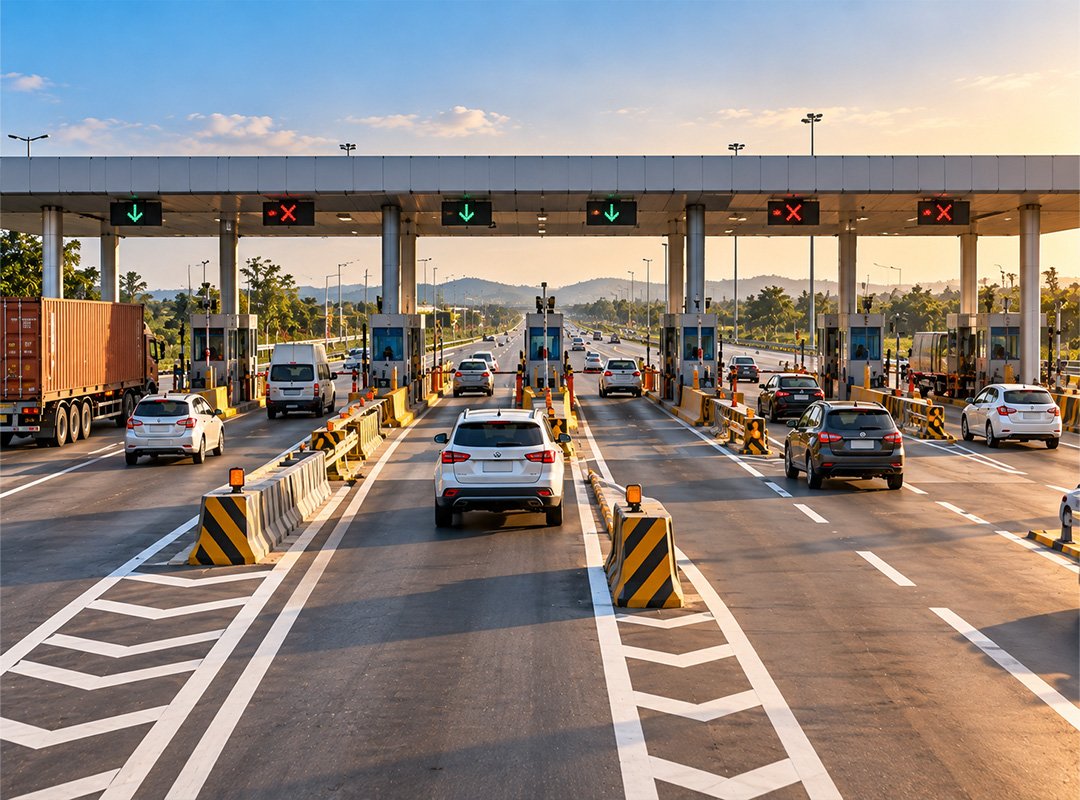
Toll plazas are important operational facilities on highways, where vehicles are processed for toll collection before continuing their journeys. Their performance depends on more than the number of toll lanes. Site selection, traffic forecasting, lane configuration, payment technology, vehicle classification and queue management must work together to maintain reliable operations. A well-planned toll plaza design accounts for expected traffic volumes, available land and the time required to process different vehicle categories. Effective highway traffic management also requires coordination between the plaza and the adjoining carriageway so that queues do not interfere with through traffic. Ultimately, toll plaza traffic flow depends on how efficiently vehicles approach, enter, pass through and leave the collection area.
1. Traffic Surveys and Demand Forecasting
The first stage involves studying existing and projected traffic conditions. Engineers assess traffic volume, vehicle classification, peak-hour demand, seasonal variations and the proportion of commercial vehicles using the route. These findings help estimate how many vehicles the plaza must process during busy periods and how demand may change over the project’s design horizon. Highway traffic management decisions should be based on representative traffic data rather than average daily traffic alone, because short periods of concentrated demand can determine queue lengths and operating requirements. The selected toll collection technology, expected transaction time and capacity of downstream roads must also be considered before finalising the proposed layout.
2. Toll Plaza Location and Site Selection
The location of a toll plaza affects both collection efficiency and highway operations. Engineers evaluate land availability, approaching traffic visibility, road geometry, proximity to intersections and railway crossings, drainage conditions and the risk of flooding. A site should provide sufficient space for approach widening, toll lanes, waiting vehicles, service facilities and safe merging after collection. Toll plaza design must also consider whether queues could extend onto junctions or sections of the highway where vehicles travel at high speeds. In India, the applicable MoRTH and IRC requirements guide site planning, while project-specific traffic studies and land constraints determine the final arrangement. A suitable location reduces operational conflicts and avoids creating an unnecessary bottleneck on the corridor.
3. Toll Lane Capacity and Configuration
The number of toll lanes must reflect the projected traffic demand, vehicle mix, collection method and service capacity of individual lanes. Too few lanes can produce long queues during peak periods, while excessive capacity may increase land, construction and operating costs without a corresponding benefit. Toll plaza design therefore requires a capacity assessment that considers both peak-hour demand and the time vehicles spend completing each transaction. Toll plaza traffic flow also depends on whether all lanes can serve the vehicles approaching them and whether sufficient capacity remains beyond the plaza. Applicable project standards prescribe the relevant design requirements, and lane provision must be verified against the governing specifications rather than selected through a general rule of thumb.
4. Approach Roads, Widening and Lane Transitions
Highway approaches must guide vehicles from the normal carriageway into the wider tolling area without sudden changes in direction or speed. This requires appropriate widening, transition tapers, lane alignment, sight distance and sufficient space for vehicles to select their intended lanes. The departure side must allow traffic to merge back into the highway without forcing vehicles into conflicting paths. Highway traffic management at this stage involves coordinating the geometry before and after the plaza, not merely arranging the toll booths. Designers must also examine how heavy vehicles negotiate the transitions, because their greater length and turning requirements can affect usable lane space. Poorly coordinated approach geometry can restrict the benefits of additional toll lanes.
5. Allocation of Lanes by Vehicle Category
Traffic composition influences how lanes should be assigned. Passenger cars, buses, trucks and oversized vehicles have different dimensions, operating characteristics and processing requirements. Toll plazas may therefore provide designated lanes or other arrangements for particular vehicle categories, subject to the approved layout and collection system. Commercial vehicles require sufficient width and clearance, while over-dimensional vehicles may need a specifically designated lane and additional operational controls. Lane allocation must also reflect the proportion of each category in the traffic stream, so that one group does not experience disproportionate delays while available capacity elsewhere remains unused. The arrangement should be clear to approaching drivers and practical for toll personnel and enforcement teams.
6. Electronic Toll Collection and FASTag Integration
Electronic toll collection reduces dependence on manual cash handling by enabling eligible vehicles to pay through compatible electronic systems. In India, FASTag uses radio-frequency identification technology to support electronic toll transactions. A properly configured system includes tag-reading equipment, vehicle or transaction records, lane controllers, network connectivity and mechanisms for handling unsuccessful or disputed transactions. Integration must ensure that equipment works reliably under expected operating conditions and that exceptions can be managed without creating unnecessary obstruction. The objective is not simply to install readers, but to connect collection technology with lane capacity and operational procedures. Reliable electronic processing can improve toll plaza traffic flow when supported by adequate infrastructure, correct vehicle classification and clear procedures for failed reads or other exceptions.
7. Toll Booths, Traffic Islands and Canopies
The physical tolling area includes booths or equipment points, traffic islands, protective barriers and the canopy where provided. These components must accommodate staff, toll equipment and the movements of passing vehicles while maintaining adequate clearance. Islands separate adjacent lanes and provide space for toll infrastructure, while suitable impact-protection arrangements help protect fixed structures from errant vehicles. The canopy must provide appropriate clearance for the vehicle categories using the plaza and accommodate lighting and required equipment. Toll plaza design also needs to account for inspection access, structural maintenance and the safe positioning of electrical and communication systems. The dimensions and protective elements must comply with the applicable standards and approved drawings for the project.
8. Queue Storage and Prevention of Highway Spillback
Queue storage is a critical consideration because vehicles waiting for toll processing need space without obstructing the main carriageway. Engineers estimate queue lengths under expected peak conditions and examine the effects of uneven lane utilisation, slow transactions, equipment failures and temporary lane closures. The holding area should provide sufficient distance between the toll point and upstream traffic, taking account of the site’s physical constraints and operating requirements. Toll plaza traffic flow can deteriorate rapidly when a queue extends beyond the designated approach area, potentially affecting vehicles that have not yet reached the plaza. Highway traffic management therefore requires monitoring queue build-up, deploying staff where necessary and opening available capacity according to operating procedures. The aim is to prevent a local delay from spreading across the adjoining highway.
9. Weigh-in-Motion Systems and Overloaded Vehicles
Commercial vehicle management can form an important part of toll-plaza planning, particularly on corridors carrying substantial freight traffic. Weigh-in-motion systems estimate vehicle weight while vehicles pass through equipped lanes, helping identify vehicles that may require further examination. Where prescribed, static weighbridges can provide a separate weighing process, while designated holding areas allow vehicles requiring enforcement action to be moved away from the main traffic stream. The layout must accommodate truck dimensions, inspection equipment, staff access and the movement of vehicles between weighing and parking areas. These facilities should be planned so that vehicle checks can be carried out without unnecessarily obstructing passenger vehicles or delaying the wider tolling operation.
10. Safety, Incident Response and Lane Control
A toll plaza brings vehicles into a controlled area where speeds, lane positions and operating conditions can change within a short distance. Its safety arrangements must address vehicle conflicts, equipment failures, breakdowns and incidents involving toll personnel or road users. Traffic islands need suitable protection, and lane equipment must be positioned to minimise exposure to moving traffic. Procedures should specify how staff respond to a disabled vehicle, an obstruction or a sudden queue, including how affected lanes are managed. Emergency access should remain available, and incident communication must be coordinated with relevant highway operating teams. These provisions help the plaza continue functioning safely when normal operations are disrupted instead of allowing an isolated incident to cause wider congestion.
11. Drainage, Lighting, Power and Communication Infrastructure
Toll plazas rely on more than civil structures and collection equipment. Surface drainage must prevent water accumulation in vehicle lanes, low points and areas occupied by electrical or communication equipment. Lighting should support visibility across approach lanes, toll points, islands and departure areas without producing excessive glare for drivers. Power supply, backup arrangements and reliable data connectivity are necessary for electronic collection equipment, monitoring systems and operational communication. Designers must also plan cable routes, equipment cabinets, maintenance access and protection against environmental exposure. These supporting systems should be considered from the design stage because retrofitting them can interrupt operations and create avoidable costs. Their reliability directly affects the ability of the plaza to deliver consistent service during different weather and operating conditions.
12. Real-Time Monitoring and Operational Management
Once a toll plaza becomes operational, its performance depends on how effectively actual traffic conditions are monitored and addressed. Operators can track transaction volumes, lane availability, equipment faults, queue lengths and unusual changes in traffic demand. This information helps determine when additional lanes or personnel are needed and when technical support should be deployed. Toll plaza traffic flow can be affected by an apparently minor issue, such as a failed reader or a lane processing vehicles more slowly than neighbouring lanes. Operating procedures should define responsibilities for fault reporting, transaction exceptions, queue control and communication with highway authorities. Regular analysis of operational records also helps identify recurring problems and supports evidence-based adjustments to staffing, equipment maintenance and lane allocation.
13. Future Expansion and Lifecycle Planning
Toll-plaza capacity should be planned with future traffic growth and changing collection technology in mind. Land reservations, service buildings, utility routes and traffic transitions may need to accommodate additional lanes or upgraded equipment later. Expansion planning should identify how construction can be undertaken while existing toll operations continue, where feasible, and which temporary arrangements would be needed during implementation. A resilient toll plaza design also considers replacement of ageing equipment, periodic resurfacing, structural inspections and access for maintenance teams. Future upgrades should not compromise the original traffic circulation plan or create new bottlenecks. By accounting for lifecycle requirements at the outset, project teams can reduce the cost and disruption associated with adapting the facility as traffic demand and operating methods evolve.
Efficient toll plazas depend on accurate demand forecasting, appropriate lane capacity, reliable payment systems and carefully planned operations. Pawan Highways India Pvt. Ltd. (PHIPL), with experience in highway construction and civil infrastructure, recognises the importance of technically sound planning and disciplined execution in developing dependable transportation networks. Well-designed toll facilities can support smoother highway traffic management while meeting the operational requirements of modern road corridors.