Highway construction represents progress. Expanding road networks, modernizing transport corridors, and building new expressways are essential for economic development, industrial growth, and regional connectivity. However, while these projects create long-term advantages, the construction phase itself often introduces serious operational challenges. Congestion, confusion, delays, and safety risks become unavoidable when major highways remain active while construction work continues simultaneously.
This is why traffic management has become one of the most critical components of modern infrastructure execution. Construction zones are highly sensitive environments where fast-moving traffic interacts with heavy machinery, restricted road space, temporary diversions, and ongoing engineering activity. Drivers are forced to adapt quickly to changing road layouts, narrowed lanes, reduced visibility, and modified speed regulations. Even a small error under these conditions can result in accidents, long traffic queues, or operational disruptions that affect thousands of commuters every day. For infrastructure companies and transportation authorities, traffic management is no longer limited to placing barricades and warning signs along the roadside. It has evolved into a specialized operational system involving engineering planning, risk assessment, technology integration, traffic forecasting, worker protection, and real-time monitoring. Modern highway projects depend heavily on structured traffic coordination to ensure that construction work progresses without creating unsafe or unmanageable roadway conditions.
As countries like India continue investing aggressively in highway expansion and expressway development, the ability to manage active traffic during construction has become increasingly important. Large-scale projects now operate under constant public scrutiny, where delays, congestion, or accidents can quickly affect both public confidence and project reputation. Effective traffic management helps balance infrastructure growth with uninterrupted mobility, making it one of the defining factors behind successful highway construction projects.
1. Protecting Road Users and Construction Workers
Safety remains the primary reason why traffic management is essential during highway construction. Construction zones are naturally unpredictable because normal traffic behavior changes significantly when drivers encounter diversions, temporary lanes, uneven surfaces, or restricted visibility. Without proper traffic control systems, confusion inside work zones can rapidly lead to collisions and dangerous driving situations.
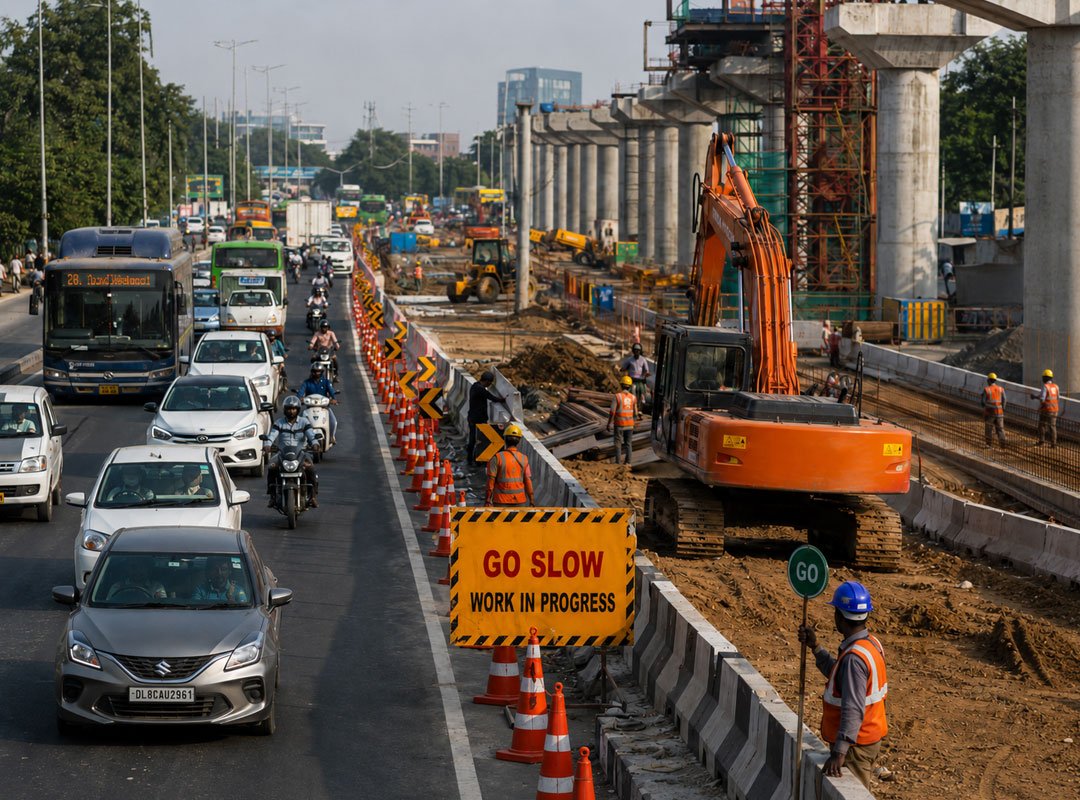
Construction workers face even greater risks because they operate only a short distance away from moving vehicles. Excavation activities, equipment movement, temporary structures, and material transportation create hazardous working conditions that become more dangerous when traffic is not properly controlled. Workers may be exposed to speeding vehicles, sudden lane changes, or distracted drivers entering restricted areas. A well-designed traffic management system creates a safer operational environment for everyone involved. Clear signage, reflective lane markings, temporary crash barriers, controlled speed zones, warning lights, and advance diversion notices help drivers understand changing road conditions before entering the construction zone. When road users receive clear guidance, they are more likely to reduce speed, follow lane discipline, and navigate construction areas safely.
The psychological aspect of driver behavior also plays a major role. Drivers become more anxious and aggressive when road conditions appear disorganized or confusing. Poorly managed work zones often trigger sudden braking, unsafe overtaking, and erratic lane changes. On the other hand, organized traffic layouts improve driver confidence and reduce panic reactions.
Nighttime construction introduces additional safety concerns. Reduced visibility, fatigue, glare from construction lighting, and slower reaction times increase accident risks significantly after dark. To address these challenges, infrastructure projects increasingly rely on illuminated lane guidance systems, reflective barriers, flashing warning lights, and specialized nighttime traffic monitoring. In many countries, highway authorities now treat work zone safety as a major performance indicator rather than a secondary operational responsibility. A technically successful highway project can still face criticism if traffic management failures lead to repeated accidents or severe public inconvenience during construction.
2. Maintaining Continuous Traffic Movement
Highways serve as critical transportation arteries that support passenger mobility, industrial logistics, freight movement, emergency services, and regional trade. Completely shutting down major corridors during construction is rarely practical because the economic and operational consequences can be severe. This makes traffic continuity one of the biggest challenges during highway development projects. Traffic management helps maintain roadway functionality while allowing construction activities to continue in parallel. Instead of closing entire highways, project teams use phased construction strategies that shift traffic gradually through temporary lanes, diversions, or controlled work zones. This approach minimizes disruption while preserving construction productivity.
Without organized traffic coordination, congestion can quickly spread beyond the immediate construction site. A poorly managed lane closure on a busy highway may create traffic queues extending several kilometers, especially during peak travel hours. In urban and industrial regions, these disruptions can affect surrounding roads, commercial activity, and public transportation systems. For example, during several phases of the Delhi-Mumbai Expressway development, temporary traffic diversions and phased lane management systems were used to maintain movement across active construction stretches. Although delays were unavoidable in some areas, structured traffic planning helped prevent complete corridor paralysis during major construction operations.
Modern traffic management focuses not only on keeping vehicles moving but also on maintaining predictable travel patterns. Drivers are more tolerant of delays when traffic flows consistently rather than stopping unpredictably for extended periods. Stable traffic movement reduces frustration and lowers the likelihood of aggressive driving behavior inside construction zones. Infrastructure planners are increasingly scheduling high-impact construction activities during off-peak hours to reduce daytime disruption. Operations such as heavy lifting, pavement installation, or structural placement are often shifted to nighttime windows when traffic density is lower. This approach helps to balance project timelines with public mobility requirements.
3. Reducing Economic Disruptions
Traffic congestion during highway construction creates economic consequences that extend far beyond commuter inconvenience. Delays increase fuel consumption, disrupt logistics schedules, reduce workforce productivity, and affect businesses dependent on reliable transportation networks. Freight transportation is particularly vulnerable to unmanaged highway disruptions. Industrial supply chains depend heavily on predictable delivery schedules, especially in sectors such as manufacturing, retail distribution, agriculture, and construction materials. Long traffic delays can increase transportation costs and affect production timelines across multiple industries.
In rapidly developing economies like India, where highways support large-scale industrial and commercial activity, maintaining traffic efficiency during construction has become an economic necessity. Major expressways connect ports, industrial corridors, warehousing hubs, and metropolitan regions that rely on uninterrupted freight movement. Traffic management reduces these disruptions through intelligent diversion planning, staggered lane closures, temporary route optimization, and dynamic traffic control systems. The objective is not to eliminate all delays, which is rarely possible during major construction, but also to reduce unnecessary congestion and maintain operational stability.
Economic losses caused by unmanaged construction zones are often underestimated. Extended travel times increase fuel usage and vehicle operating costs while reducing overall transportation efficiency. Emergency services may also experience delayed response times in heavily congested areas, creating additional public safety concerns. Governments and infrastructure companies increasingly recognize that traffic management is directly connected to project economics. A project completed on schedule but associated with prolonged traffic chaos can still generate public dissatisfaction and financial inefficiencies. Effective traffic coordination helps protect both infrastructure investment and regional economic activity during construction periods.
4. Improving Driver Awareness and Discipline
Driver behavior strongly influences the success of traffic management inside highway construction zones. Construction areas naturally create frustration because drivers encounter delays, reduced speed limits, narrow lanes, and temporary road changes that interrupt normal travel patterns. Without proper traffic guidance, frustrated drivers may begin overspeeding, weaving between lanes, ignoring warning signs, or attempting unsafe overtaking maneuvers. Distracted driving becomes particularly dangerous inside construction zones where roadway conditions can change rapidly over short distances. Effective traffic management reduces uncertainty by making traffic patterns easier to understand. Gradual lane transitions, visible warning systems, reflective markings, and advance directional signage help drivers anticipate changes before reaching restricted areas.
Consistency is extremely important in work zone design. Sudden changes in lane structure or unclear diversion routes increase confusion and accident risks. Well-managed construction zones provide enough reaction time for drivers to adjust speed and positioning safely. Public communication also plays an increasingly important role in modern traffic coordination. Highway authorities now use digital message boards, navigation app integration, social media alerts, and live traffic updates to inform commuters about congestion, alternate routes, and expected delays before they enter active construction zones. This proactive communication helps reduce panic reactions and improves overall compliance with traffic restrictions. Drivers who understand the reason behind traffic controls are generally more cooperative and less likely to engage in risky driving behavior.
5. Supporting Construction Productivity
Traffic management is closely linked to construction efficiency. Poorly coordinated traffic systems can interfere with material transportation, equipment movement, workforce access, and operational scheduling inside active work zones. Construction teams require stable working conditions to maintain productivity and safety. Frequent traffic interruptions, unauthorized vehicle entry, or congestion near work areas can slow operations and increase operational risks. Effective traffic coordination creates controlled environments where engineering teams can perform work more efficiently. For example, during bridge construction or pavement rehabilitation projects, heavy machinery often needs uninterrupted access to specific sections of the highway. Traffic management systems help isolate these work areas while maintaining controlled vehicle movement nearby.
Operational stability also improves coordination between contractors, equipment operators, safety teams, and transportation authorities. When traffic flow remains predictable, project managers can schedule activities more accurately and reduce costly delays. In large-scale infrastructure projects, delays caused by traffic-related complications can significantly increase project costs. Extended equipment rental periods, labour inefficiencies, fuel expenses, and schedule overruns can place substantial financial pressure on infrastructure companies. This is one reason why traffic management is increasingly integrated into the early planning phase of highway construction rather than treated as a temporary operational requirement after construction begins.
6. The Growing Influence of Smart Traffic Technology
Technology is transforming how highway construction traffic is managed worldwide. Traditional systems based only on static signage and manual supervision are gradually being replaced by intelligent transportation solutions capable of monitoring and responding to traffic conditions in real time. Digital Variable Message Signs are now widely used to provide live updates regarding lane closures, congestion levels, weather conditions, alternate routes, and estimated travel delays. These systems improve driver awareness before vehicles reach active work zones.
Traffic surveillance technology has also become more advanced. Cameras, sensors, drones, and GPS-based monitoring systems help project teams analyze traffic density, detect bottlenecks, and respond quickly to developing congestion. Some advanced highway projects now use AI-driven traffic analysis systems capable of predicting congestion patterns based on vehicle volume and travel behavior. These systems allow operators to adjust lane configurations or diversion strategies dynamically depending on current traffic conditions. Navigation platforms such as Google Maps and integrated highway traffic systems also influence modern construction traffic planning. Real-time route updates help distribute traffic more efficiently across alternate corridors during major construction activities. As transportation infrastructure becomes increasingly digitized, smart traffic coordination will likely become standard practice across future highway projects.
7. Traffic Management in the Indian Highway Sector
India’s highway infrastructure sector is undergoing rapid expansion through expressway construction, corridor modernization, bypass development, and national highway upgrades. Rising urbanization, industrial growth, and vehicle ownership have significantly increased traffic density across major transportation routes. This growth has made construction zone management far more complex than in previous decades. Indian highways often carry highly mixed traffic patterns involving commercial trucks, buses, private vehicles, motorcycles, agricultural transport, and local traffic operating simultaneously under varying road conditions. Managing construction activity within these environments requires highly adaptive traffic planning. Work zones must accommodate heavy freight movement while maintaining safe conditions for passenger traffic and regional mobility.
Projects such as the Dwarka Expressway, Delhi-Mumbai Expressway, and multiple NHAI corridor upgrades demonstrate how modern highway development increasingly depends on sophisticated traffic coordination systems to maintain operational continuity during construction. Infrastructure companies operating in India now face growing expectations regarding safety, mobility, and public communication. Successful project execution depends not only on engineering quality but also on how effectively traffic movement is maintained throughout the construction lifecycle. As India continues investing heavily in transportation modernization, traffic management will become even more important in determining project efficiency, public acceptance, and long-term infrastructure reliability. Traffic management during active highway construction is far more than a temporary support activity. It is a critical operational system that directly affects safety, mobility, economic continuity, construction productivity, and public confidence. Well-managed construction zones reduce accident risks, preserve traffic flow, support freight movement, and create safer environments for both road users and construction workers. Poorly managed traffic conditions, however, can undermine even technically successful infrastructure projects by creating congestion, delays, confusion, and safety failures.
The future challenge for highway development is not simply building roads faster. It is maintaining uninterrupted mobility while construction activity expands across already congested transportation networks. As traffic volumes continue rising and infrastructure projects become more complex, the role of intelligent traffic coordination will only grow stronger. Modern infrastructure development depends not only on engineering excellence but also on the ability to keep people, goods, and cities moving safely while that infrastructure is being built.