Monsoon conditions remain one of the biggest operational challenges in highway infrastructure development. Continuous rainfall affects earthwork, pavement construction, drainage systems, material handling, labor productivity, machinery movement, and overall site execution efficiency. In large-scale highway projects, even short periods of intense rainfall can disrupt construction schedules, increase operational costs, and reduce project productivity significantly. The Monsoon Impact on Highway Construction is particularly severe in regions experiencing prolonged rainfall and unstable soil conditions. Excess moisture weakens embankments, delays compaction activities, damages pavement layers, and increases erosion risks across active construction zones. These disruptions directly affect project timelines, construction quality, and long-term infrastructure durability.
India receives nearly 75% of its annual rainfall during the southwest monsoon season. According to the India Meteorological Department, the country records an average annual rainfall of approximately 1,170 mm, while several regions receive rainfall exceeding 2,500 mm annually. Such weather conditions create major operational difficulties for highway developers, contractors, and infrastructure agencies across the country. India has over 6.3 million kilometers of road network, and highways alone carry nearly 65% of freight traffic and around 80% of passenger movement. Delays caused by adverse weather conditions affect supply chains, logistics operations, fuel consumption, transportation efficiency, and industrial connectivity on a large scale. The growing focus on Highway Construction During Rainy Season reflects the increasing need for weather-responsive planning, climate-resilient engineering, and better execution strategies. Infrastructure developers like Pawan Highways India Pvt. Ltd. (PHIPL) are now investing heavily in advanced drainage systems, weather forecasting tools, geotechnical monitoring, and modern construction technologies to address broader Monsoon Challenges in Infrastructure Projects more effectively.
1. Impact on Earthwork and Soil Stability
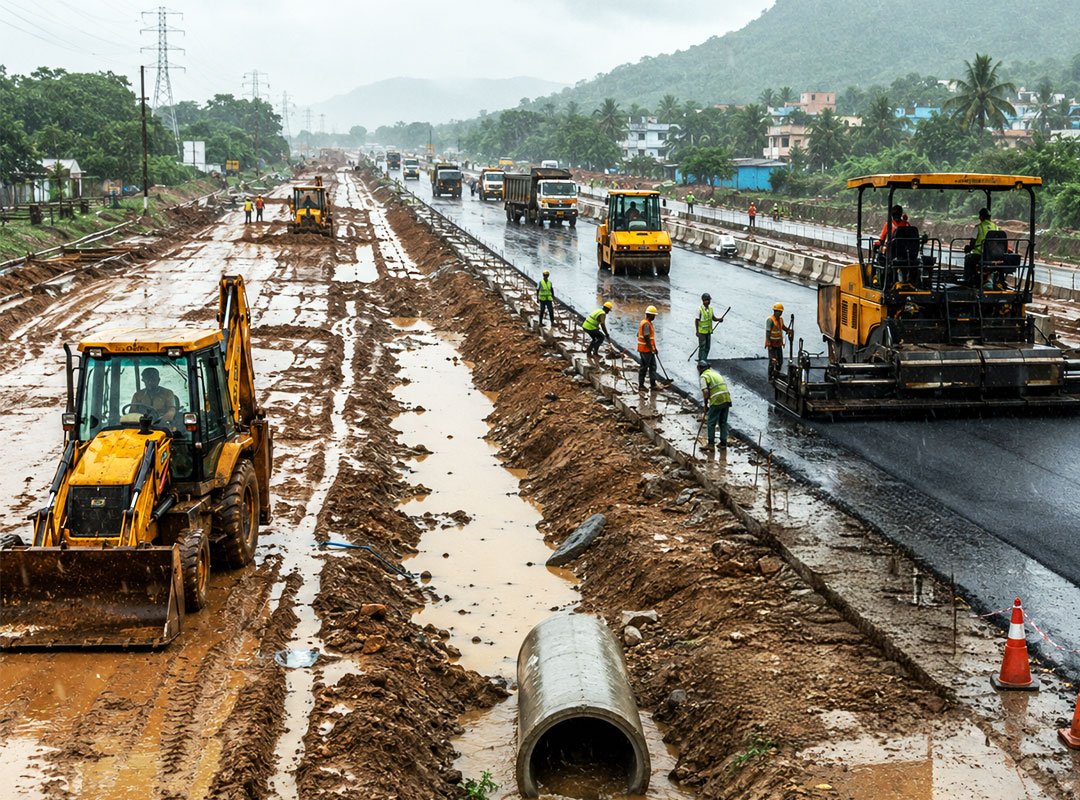
Earthwork activities are among the most heavily affected operations during monsoon periods. Highway construction depends extensively on excavation, embankment development, grading, filling, and compaction activities, all of which require controlled moisture levels to achieve proper soil density and structural stability. The Monsoon Impact on Highway Construction becomes particularly severe during earthwork execution because saturated soil loses its load-bearing capacity and becomes unsuitable for compaction. Wet soil conditions reduce engineering strength and create instability across embankments and excavation zones. Clay-rich and black cotton soils become highly problematic during prolonged rainfall because they absorb water rapidly and expand significantly. Excessive moisture weakens soil structure and increases the likelihood of settlement, deformation, and surface instability. Heavy rainfall also accelerates erosion across partially completed embankments and side slopes. Flowing rainwater removes protective soil layers and damages unfinished earthwork surfaces, especially in areas lacking proper slope protection measures. This increases restoration work, material consumption, and execution delays. Machinery movement becomes increasingly difficult on saturated ground conditions. Excavators, graders, compactors, and dumpers lose traction and operational efficiency on muddy surfaces, reducing daily productivity across active construction zones. During peak monsoon periods, many highway projects temporarily suspend earthwork activities because stable compaction and safe machinery operations become difficult to maintain under excessive moisture conditions.
2. Challenges in Drainage Management
Drainage management becomes one of the most critical aspects of highway construction during monsoon seasons. Poor water flow control can halt construction activities, weaken pavement foundations, damage structures, and create unsafe working environments. One of the major Monsoon Challenges in Infrastructure Projects is the failure of temporary and permanent drainage systems during heavy rainfall. Construction sites require diversion channels, catch drains, pumping systems, and temporary culverts to prevent water accumulation around active work zones. Without proper drainage planning, construction areas quickly become waterlogged. Standing water delays excavation activities, damages subgrade layers, and increases the risk of structural instability across partially completed sections. Poor drainage is also one of the leading causes of premature highway deterioration in high-rainfall regions. Water infiltration weakens pavement foundations and reduces subgrade strength over time. Continuous moisture exposure eventually causes cracking, rutting, pothole formation, and pavement settlement. Subsurface drainage failures are particularly damaging because trapped water remains beneath pavement layers for extended periods. This reduces pavement life and increases long-term maintenance requirements significantly. Effective drainage planning has therefore become a major priority for infrastructure developers working in rainfall-prone regions.
3. Effects on Asphalt and Pavement Construction
Bituminous pavement construction is extremely sensitive to rainfall and moisture exposure. Asphalt paving requires dry surfaces and controlled environmental conditions to ensure proper bonding and compaction between pavement layers. The challenges associated with Highway Construction During Rainy Season become especially serious during asphalt paving operations. Moisture contamination in aggregates affects the adhesion between bitumen and stone surfaces, leading to stripping and premature pavement failures. Rainwater also disrupts asphalt temperature control during transportation and laying operations. If hot mix asphalt cools below specified limits before compaction, pavement density and structural performance are compromised considerably. Newly constructed roads exposed to excessive moisture during paving operations often develop potholes, cracks, rutting, and surface deterioration much earlier than expected. Contractors frequently face additional repair and restoration expenses due to weather-related pavement damage. Continuous rainfall also interrupts paving schedules repeatedly, reducing execution efficiency and increasing idle time for machinery and labor teams. To reduce moisture-related risks, contractors increasingly rely on improved paving technologies, moisture-resistant materials, and weather-responsive scheduling systems.
4. Impact on Concrete Structures
Concrete operations become highly vulnerable during monsoon execution. Highway projects involve large-scale concrete work for bridges, culverts, retaining walls, flyovers, rigid pavements, and drainage structures. The Monsoon Impact on Highway Construction is strongly connected to the vulnerability of concrete structures during wet weather conditions. Rainfall during concrete pouring and curing alters the water-cement ratio and reduces compressive strength significantly. Excess moisture exposure during setting periods can lead to cracking, poor finishing, surface scaling, and long-term durability issues. Maintaining proper curing conditions becomes extremely difficult during continuous rainfall events. Bridge construction activities face additional operational risks because wet reinforcement surfaces, slippery platforms, and strong winds reduce execution safety in elevated work zones. Foundation and piling operations also become difficult in flood-prone areas where rising water levels submerge excavation pits and delay structural activities for extended durations. River bridge construction projects experience severe disruptions during monsoon flooding because underwater work zones and temporary support systems become unstable under changing water flow conditions.
5. Material Handling and Storage Problems
Monsoon conditions create major difficulties in construction material storage and transportation management. Highway projects consume large quantities of cement, aggregates, steel, fuel, sand, and construction chemicals, all of which are sensitive to moisture exposure. Cement requires completely waterproof storage conditions because even limited humidity exposure reduces its strength and binding performance. Wet aggregates and mud contamination also affect concrete and asphalt mix consistency. Storage yards frequently become muddy and inaccessible during heavy rainfall. Water accumulation damages packaging materials and complicates loading and unloading operations across construction sites.
Transportation disruptions are equally problematic during monsoon periods. Access roads deteriorate rapidly due to flooding, waterlogging, and surface damage, affecting the movement of trucks carrying construction materials and equipment. Delayed material supply affects batching schedules, machinery deployment, labor allocation, and overall site coordination. These disruptions reduce operational efficiency and increase project delays significantly. Such issues represent some of the most persistent Monsoon Challenges in Infrastructure Projects, particularly in remote highway corridors and difficult terrain conditions.
6. Decline in Labor Productivity
Labor productivity declines considerably during prolonged monsoon conditions. Highway construction remains highly labor-intensive despite increasing mechanization across infrastructure projects. The realities of Highway Construction During Rainy Season directly affect workforce efficiency because slippery surfaces, muddy terrain, and waterlogged work areas slow down movement and increase physical fatigue among workers. Continuous exposure to wet conditions also affects concentration, morale, and operational consistency across active construction zones. Workers require more time to complete routine activities under unstable site conditions. Absenteeism rates often increase during monsoon periods due to transportation disruptions, flooded access routes, and seasonal health issues. Reduced manpower availability further affects execution schedules and site productivity. Labor-dependent operations such as reinforcement fixing, formwork installation, manual grading, drainage cleaning, and finishing work progress much slower during adverse weather conditions. Contractors frequently struggle to maintain planned execution targets because workforce productivity becomes unpredictable during prolonged rainfall periods.
7. Safety Risks on Construction Sites
Monsoon conditions significantly increase safety risks across highway construction projects. Wet surfaces, unstable excavations, reduced visibility, and electrical hazards create dangerous working environments for workers and machinery operators. Excavation trenches filled with rainwater become highly unstable and vulnerable to sudden collapse. Workers operating near deep excavation zones face increased risks of injury and entrapment during heavy rainfall conditions. Temporary retaining systems and slope protection measures also weaken due to continuous moisture exposure. Poorly stabilized surfaces may fail unexpectedly under saturated conditions. Electrical safety becomes another major concern during monsoon operations. Water exposure around generators, cables, lighting systems, and temporary electrical installations increases the possibility of electrocution and equipment failure. Construction vehicles operating on slippery terrain experience reduced traction and lower operational control. Poor visibility during storms further increases collision risks involving dumpers, cranes, compactors, and excavators. The increasing number of weather-related site incidents highlights the serious Monsoon Impact on Highway Construction from a workforce safety perspective.
8. Machinery Performance and Maintenance Challenges
Heavy construction equipment experiences reduced efficiency during monsoon execution. Machinery operating on saturated ground conditions faces traction loss, higher fuel consumption, and increased maintenance requirements. Mud accumulation affects hydraulic systems, undercarriage components, bearings, and engine performance. Continuous water exposure accelerates corrosion and damages sensitive electrical systems within construction machinery. Excavators, pavers, compactors, and graders lose operational effectiveness on wet surfaces because stability and maneuverability become difficult to maintain under muddy conditions. Daily productivity declines because machinery movement becomes slower and less reliable across waterlogged work zones. Frequent cleaning and preventive maintenance become essential to avoid major mechanical failures. Contractors also incur additional expenses due to equipment downtime, spare part replacement, emergency repairs, and extended maintenance cycles during rainy seasons. These operational disruptions remain one of the most difficult Monsoon Challenges in Infrastructure Projects involving continuous heavy equipment deployment.
9. Financial Impact of Monsoon Delays
Monsoon-related disruptions create substantial financial pressure on highway infrastructure projects. Delayed execution increases labor expenses, machinery rental costs, fuel consumption, project overheads, and financing charges. The financial burden associated with Highway Construction During Rainy Season becomes more severe under strict contractual timelines and fixed completion schedules. Extended project durations often lead to penalty clauses, reduced contractor profitability, and higher inflation-related material costs. Weather-related restoration work creates another major financial challenge. Damaged embankments, eroded slopes, flooded work zones, and failed pavement sections require immediate repair and reconstruction activities. Contractors operating on low profit margins face considerable financial stress when rainfall interruptions repeatedly affect productivity and execution continuity. Unplanned downtime also reduces equipment utilization efficiency, increasing operational costs across large-scale infrastructure projects.
10. Impact of Climate Change on Highway Execution
Climate change has intensified the operational difficulties associated with monsoon construction activities. Rainfall patterns have become increasingly unpredictable, with shorter but more intense rainfall events causing flash floods, rapid erosion, and severe water accumulation. Traditional planning methods based on historical rainfall trends are becoming less reliable under changing climate conditions. Infrastructure developers are now preparing for extreme weather variability rather than average seasonal rainfall behavior. Many regions experience sudden high-intensity storms that exceed the design capacity of temporary drainage systems and erosion protection measures. Such conditions increase the likelihood of site flooding, embankment failure, and structural instability during active construction phases. The connection between climate variability and Monsoon Impact on Highway Construction is becoming increasingly evident as weather-related disruptions continue to affect infrastructure execution across multiple regions. As a result, climate-resilient engineering practices are becoming essential for future highway projects. Infrastructure developers are investing more heavily in advanced drainage systems, geosynthetics, erosion control technologies, weather monitoring systems, and adaptive construction methods to improve resilience against rainfall-related risks.
11. Importance of Strategic Planning and Modern Technology
Effective planning remains one of the most important factors in reducing monsoon-related disruptions in highway projects. Successful infrastructure execution requires seasonal weather analysis during the earliest planning stages. Critical operations such as earthwork, asphalt paving, and foundation activities are increasingly scheduled outside peak rainfall periods whenever possible. Contractors who align execution plans with regional weather patterns generally achieve better productivity and lower operational risk exposure. Advanced weather forecasting systems now play a major role in highway project management. Real-time rainfall monitoring and predictive analytics help construction teams improve operational planning during uncertain weather conditions. Drone surveys and digital monitoring systems allow engineers to assess erosion, drainage performance, slope stability, and water accumulation more efficiently during rainfall events.
Geotechnical sensors installed in vulnerable areas provide early warning signs related to embankment movement and structural instability. These systems improve decision-making and reduce the risk of large-scale operational failures. The increasing adoption of technology is helping infrastructure developers address major Monsoon Challenges in Infrastructure Projects through better preparedness, faster response systems, and improved operational visibility. Modern materials such as polymer-modified bitumen, geotextiles, and rapid-setting concrete mixes are also improving highway durability under moisture-prone conditions. Precast construction methods are gaining wider acceptance because they reduce weather dependency during execution.
Monsoon conditions continue to remain one of the most significant operational risks in highway infrastructure development. Rainfall affects nearly every stage of execution, including earthwork, drainage systems, pavement construction, concrete operations, machinery deployment, labor productivity, and worker safety. The growing Monsoon Impact on Highway Construction highlights the need for stronger planning, climate-responsive engineering, and improved operational management across infrastructure projects. Construction companies that invest in advanced drainage systems, weather monitoring tools, resilient materials, and modern construction technologies are better prepared to manage rainfall-related disruptions effectively. The realities of Highway Construction During Rainy Season demand adaptive execution strategies, stronger safety systems, and better coordination across all construction activities. Maintaining productivity and construction quality during adverse weather conditions requires both technical expertise and operational preparedness. At the same time, addressing broader Monsoon Challenges in Infrastructure Projects will become increasingly important as climate change continues to intensify rainfall unpredictability and extreme weather events. The future of highway infrastructure development will depend heavily on climate resilience, technological adaptation, and sustainable construction practices. While monsoon-related disruptions cannot be eliminated entirely, their impact can be controlled through proper planning, engineering efficiency, and long-term infrastructure resilience strategies.