India’s road infrastructure has evolved rapidly over the last two decades. While highways have long served as the backbone of transportation and trade, expressways represent the next stage of infrastructure development focused on speed, safety, efficiency, and long-term economic impact. Discussions around the Difference Between Expressways and Highways have become increasingly relevant as India continues investing in high-capacity transport corridors across the country.
India today has one of the fastest-growing road infrastructure networks in the world, supported by large-scale initiatives such as Bharatmala Pariyojana, industrial corridor development, and multimodal logistics expansion. As connectivity demands continue to rise, expressways are emerging as critical infrastructure assets for economic growth, freight mobility, and regional development. Although highways and expressways may appear similar to the general public, their construction philosophy, engineering standards, design requirements, execution methods, and operational objectives are significantly different. Understanding the Expressway Construction vs Highway Construction approach is essential for infrastructure developers, policymakers, logistics operators, and transportation planners.
Expressway construction is not simply about building a wider road. It involves advanced engineering, controlled mobility planning, high-speed traffic management, precision construction practices, intelligent transportation systems, and long-term sustainability considerations. The complexity of expressway development is considerably higher compared to regular highway construction because expressways are designed for uninterrupted, high-speed travel with minimal conflict points and maximum operational efficiency. This evolution is a major part of Modern Expressway Infrastructure Development in India.
For infrastructure companies involved in large-scale transportation development, understanding these differences is essential because expressways demand greater technical expertise, better project coordination, stricter quality control, and advanced construction methodologies.
1. Difference in Design Philosophy
The most fundamental aspect in understanding the Difference Between Expressways and Highways lies in their design philosophy. Regular highways are designed to connect cities, towns, industrial areas, and rural regions while allowing direct access from adjoining roads, markets, villages, and commercial establishments. Their objective is connectivity and accessibility. Expressways, on the other hand, are designed for controlled and uninterrupted mobility. Their purpose is to move high volumes of traffic at high speeds over long distances with minimal interruptions. This requires eliminating direct roadside access, reducing intersections, controlling entry and exit points, and ensuring uninterrupted traffic flow. Every engineering decision in high-speed corridor engineering revolves around speed consistency, traffic efficiency, and safety under high-speed conditions.
2. Controlled Access Infrastructure
One of the defining characteristics highlighted in Expressway Construction vs Highway Construction is controlled access infrastructure. Regular highways allow vehicles, pedestrians, local traffic, and roadside activities to interact directly with the roadway. This creates multiple conflict points and reduces travel efficiency. Expressways eliminate these disruptions through grade-separated interchanges, designated entry and exit ramps, service roads, fencing, and restricted crossings. Vehicles can only enter or exit at specific locations. This controlled access system requires additional infrastructure such as flyovers, underpasses, overpasses, acceleration lanes, deceleration lanes, toll systems, and service corridors. The construction of these components adds significant complexity compared to standard highway projects.
3. High-Speed Geometric Design Standards
Regular highways are generally designed for moderate operational speeds depending on terrain, traffic density, and regional requirements. Expressways are engineered for consistently high-speed travel, often ranging between 100 km/h and 120 km/h or more depending on national standards. To safely support these speeds, controlled-access roadway construction demands wider lane geometry, larger curve radii, smoother gradients, enhanced pavement quality, superior drainage systems, and highly accurate alignment planning. Minor design inconsistencies that may be manageable on regular highways can become major safety risks on expressways due to higher vehicle speeds. This is one of the most important technical factors in the Difference Between Expressways and Highways.
4. Advanced Pavement Engineering
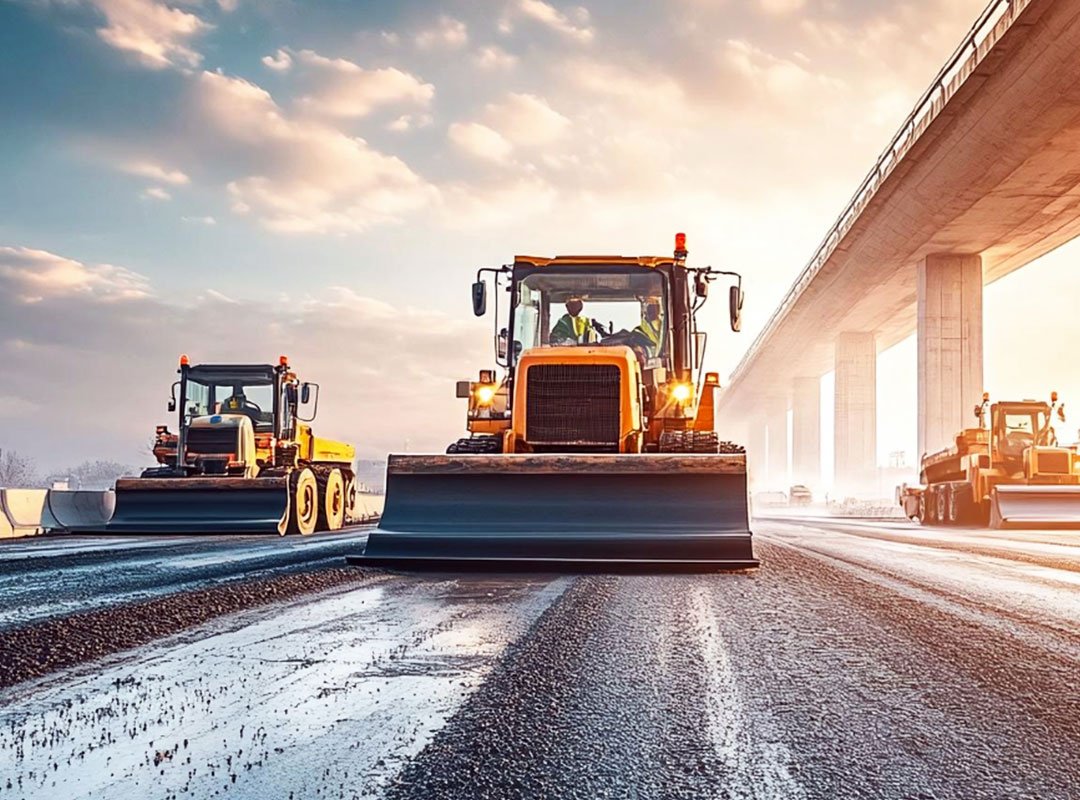
Expressways experience significantly higher traffic loads, especially from commercial and heavy freight vehicles. As a result, pavement engineering for expressways is more sophisticated than regular highway construction. Expressway pavements are designed for longer service life, higher durability, and better load distribution. The pavement layers are thicker and constructed with tighter material specifications. Advanced testing methods are used to evaluate subgrade strength, moisture content, compaction quality, and bituminous performance. In many projects, mechanized paving systems, sensor-based monitoring, and automated compaction technologies are deployed to ensure consistency across long stretches. These technologies are now becoming standard in Modern Expressway Infrastructure Development projects across India. Additionally, pavement smoothness standards on expressways are much stricter because even minor surface irregularities can impact high-speed vehicle stability and ride quality.
5. Greater Emphasis on Safety Engineering
Safety considerations in expressway development are substantially more rigorous than in regular highway projects. High-speed traffic environments leave less room for driver error, making safety engineering a central component of project planning and execution. Expressways incorporate crash barriers, median barriers, anti-glare screens, rumble strips, reflective signage, intelligent lane markings, emergency lay-bys, surveillance systems, and advanced lighting systems. Bridge railings, embankment protections, slope stabilization systems, and impact attenuation structures are also designed to meet stricter safety standards. These safety upgrades clearly define the Difference Between Expressways and Highways from an operational perspective. Construction zones on expressway projects also require advanced traffic management systems because worksite hazards at high speeds can result in severe accidents if not managed properly.
6. Extensive Land Acquisition Requirements
Expressway projects generally require significantly larger land parcels than regular highways. Since expressways include controlled access corridors, service roads, toll plazas, interchanges, utility zones, drainage networks, green belts, and future expansion provisions, the overall right-of-way width is much larger. Land acquisition for expressways is therefore more complex and sensitive. It involves coordination with multiple stakeholders, rehabilitation planning, environmental approvals, utility relocation, and compensation frameworks. Delays in land acquisition are among the biggest challenges in corridor development because incomplete stretches directly impact project continuity and execution timelines. Efficient corridor planning is now a major part of Modern Expressway Infrastructure Development strategies.
7. Complex Interchange Construction
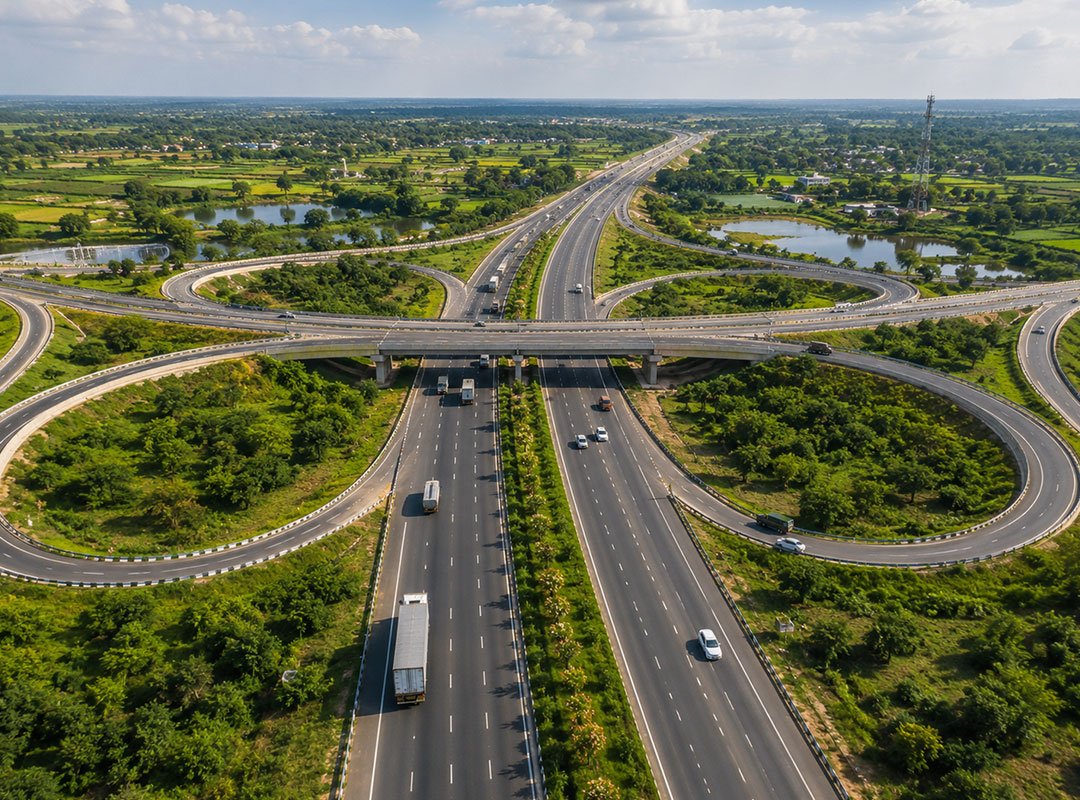
Regular highways primarily rely on intersections, roundabouts, and traffic signals for connectivity. Expressways avoid these interruptions through large-scale interchanges that allow seamless vehicle movement between corridors. Interchange construction is one of the most technically demanding aspects of expressway projects. Cloverleaf interchanges, trumpet interchanges, directional ramps, stack interchanges, and grade separators require advanced structural engineering, traffic simulation analysis, and precision execution. These structures involve extensive earthwork, retaining systems, bridge construction, reinforced concrete works, and drainage integration. This level of complexity is a defining factor in Expressway Construction vs Highway Construction.
8. Advanced Drainage and Water Management Systems
Drainage design is a critical factor in expressway construction because water accumulation at high speeds can lead to hydroplaning, pavement damage, and safety hazards. Expressways therefore require highly efficient surface and subsurface drainage systems. Compared to regular highways, expressways incorporate larger drainage networks, longitudinal drains, median drains, culverts, stormwater channels, rainwater harvesting systems, and erosion control measures. Hydrological studies are conducted extensively to evaluate rainfall intensity, flood risks, soil permeability, and water discharge patterns. Advanced water management practices are now central to Modern Expressway Infrastructure Development. Proper water management also improves pavement longevity and reduces maintenance requirements over the long term.
9. Intelligent Transportation Systems (ITS)
Modern expressways increasingly integrate Intelligent Transportation Systems to improve operational efficiency, traffic monitoring, and emergency response capabilities. Regular highways may have basic traffic management infrastructure, but expressways rely heavily on digital systems. ITS infrastructure includes electronic toll collection systems, traffic surveillance cameras, variable message signs, automatic incident detection systems, weather monitoring systems, speed enforcement systems, and centralized traffic control centers. Fiber optic communication networks and real-time data monitoring platforms are also integrated into expressway infrastructure. These digital integrations showcase the rapid growth of Modern Expressway Infrastructure Development in India. The inclusion of ITS transforms expressways into technologically advanced transportation corridors rather than simply road networks.
10. Massive Earthwork and Corridor Preparation
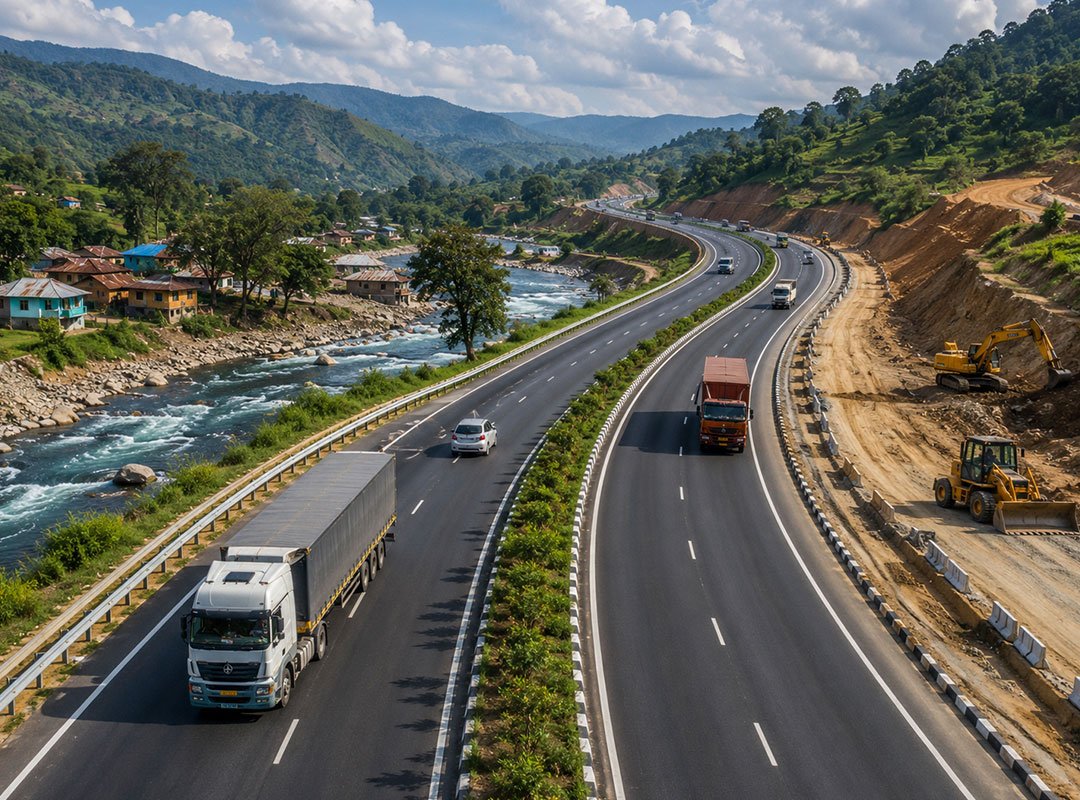
Expressway construction involves massive earthwork activities because the corridor must maintain consistent geometry suitable for high-speed travel. This often requires extensive cutting, filling, embankment development, slope stabilization, and terrain modification. Unlike regular highways that may adapt more closely to existing terrain conditions, expressways demand smoother vertical and horizontal alignments. Large quantities of soil, aggregates, and construction materials must therefore be transported, processed, and compacted systematically. The scale of these activities is another major distinction in Expressway Construction vs Highway Construction. Heavy-duty construction equipment, automated grading systems, GPS-controlled machinery, and large-scale material logistics become essential for maintaining efficiency and accuracy.
11. Stricter Quality Control Standards
Quality control requirements in expressway construction are substantially more demanding because operational failure or deterioration can have severe safety and economic consequences. Material testing frequency is higher, construction tolerances are tighter, and inspection protocols are more comprehensive. Laboratories are often established at project sites to continuously test aggregates, bitumen, concrete, soil strength, density, and pavement performance. Third-party quality audits, digital reporting systems, drone monitoring, and real-time construction tracking are increasingly used to ensure compliance with national and international standards. Such practices are becoming benchmarks in Modern Expressway Infrastructure Development.
12. Environmental and Sustainability Considerations
Large-scale expressway projects have substantial environmental impacts, making sustainability planning a critical aspect of construction. Environmental management requirements are generally more extensive compared to regular highway projects. Expressway construction often includes wildlife crossings, noise barriers, green corridors, plantation programs, dust suppression systems, erosion control measures, and water conservation initiatives. Environmental impact assessments are more detailed because expressways pass through larger geographic regions and sensitive ecological zones. Sustainability-focused planning further highlights the Difference Between Expressways and Highways in modern infrastructure projects. Sustainable construction materials, recycling techniques, energy-efficient lighting systems, and carbon reduction strategies are also gaining importance in modern expressway development.
13. Capital Intensity and Lifecycle Investment
Expressway construction costs are significantly higher than regular highway projects due to the scale of infrastructure involved. Controlled access systems, large interchanges, advanced pavement layers, bridges, ITS integration, utility corridors, safety infrastructure, and land acquisition collectively increase project expenditure. However, expressways also deliver higher long-term economic returns through reduced travel time, lower vehicle operating costs, fuel savings, improved freight movement, and regional economic development. The investment is therefore justified through long-term infrastructure efficiency and national economic growth. This economic value is often central to discussions around Expressway Construction vs Highway Construction.
Expressway construction is fundamentally different from regular highway construction in terms of engineering complexity, operational objectives, construction technology, safety standards, quality requirements, and infrastructure integration. While highways primarily focus on connectivity and accessibility, expressways are designed for controlled, high-speed, uninterrupted mobility supported by advanced infrastructure systems.
The discussion around Expressway Construction vs Highway Construction goes far beyond road width or travel speed. It includes advanced engineering systems, operational efficiency, intelligent traffic management, sustainability planning, and long-term economic value creation. As India accelerates investment in next-generation transportation corridors, infrastructure companies with strong engineering capabilities, execution efficiency, and quality-driven construction practices will play a defining role in the future of mobility. Expressway development is no longer just about road construction. It is about building faster, safer, and economically transformative infrastructure that supports long-term national growth.