A highway safety barrier is not simply a physical wall placed beside a road. It is a deliberately engineered roadside safety system designed to reduce the consequences of a vehicle leaving its intended path. Depending on the location and hazard, a barrier may need to contain and redirect a vehicle, limit its penetration into opposing traffic or hazardous terrain, control impact severity, and prevent the vehicle from vaulting over or passing underneath the system.
The Ministry of Road Transport and Highways (MoRTH) identifies crash barriers as an important treatment at hazardous locations such as high embankments, valley sides, sharp curves and tunnel approaches. It refers to IRC:119-2015, Guidelines for Traffic Safety Barriers, for detailed installation requirements. India’s road safety framework also treats barriers as one component of broader engineering measures rather than as an independent safety device.
The need for these systems is significant. MoRTH’s Road Accidents in India 2023 reported 4,80,583 road accidents and 1,72,890 fatalities nationally during 2023. National Highways, including Expressways, accounted for 1,50,177 reported accidents and 63,112 fatalities. These figures do not mean barriers alone can prevent crashes, but they underline why engineered roadside protection forms an important part of highway design.
For Pawan Highways India Pvt. Ltd. (PHIPL), a highway construction company involved in infrastructure execution, understanding how these systems work is important because barrier selection, placement and installation influence the safety performance of the completed road.
1. Barriers Are Installed to Manage Specific Hazards
A barrier is generally warranted when leaving the roadway could produce a more severe consequence than striking the barrier itself. MoRTH’s guidelines state that the fundamental purpose is to absorb impact energy and reduce accident severity. Typical hazards include steep embankments, bridge structures, rigid roadside objects, dangerous curves, median conflicts and tunnel approaches. This means highway safety barriers are not intended to line every kilometre of road automatically. Their location should be determined by the hazard, road geometry, traffic conditions and consequences of a vehicle leaving the carriageway.
2. Containment and Redirection Are the Two Core Functions
A properly designed barrier has to do more than stop a vehicle. MoRTH’s barrier guidance specifies that the system should contain and redirect the vehicle without allowing it to penetrate or vault over the barrier. At the same time, it should avoid causing sudden deceleration or spinning and should minimise the vehicle’s intrusion into adjacent traffic lanes. This balance is central to crash barrier design. A stronger barrier is not automatically a safer barrier if the impact becomes excessively severe for vehicle occupants.
3. The Barrier Type Depends on the Location
Indian highway projects use different barrier systems according to the required performance and available space. MoRTH and IRC guidance recognise rigid, semi-rigid and flexible barriers. Concrete barriers provide high containment with limited deflection, while metal beam and wire-rope systems can deform during impact and dissipate energy over a greater distance. A 2023 IRC technical article notes that New Jersey or thrie-beam barriers are considered appropriate in constrained hilly conditions, while thrie-beam systems may be used on expressways and high-speed corridors. The selection is therefore driven by site conditions rather than by one universal barrier type.
4. W-Beam Barriers Use Controlled Deformation
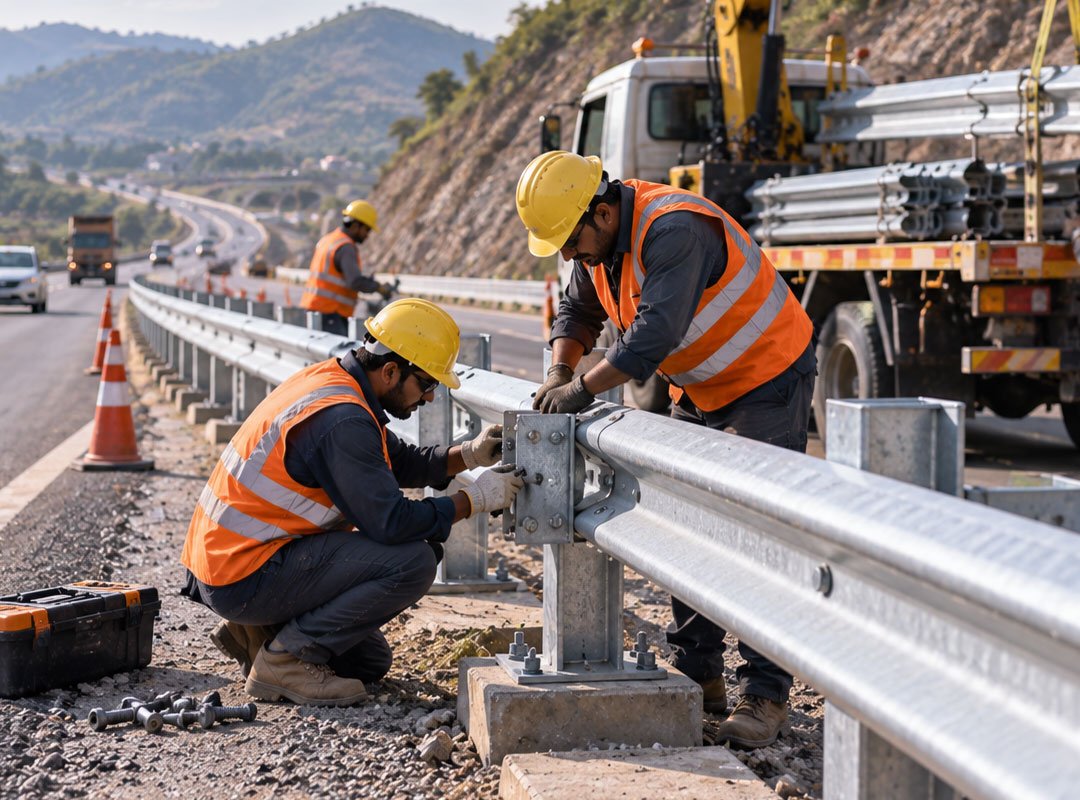
The familiar corrugated W-shaped metal barrier is designed to deform when struck. The beam, spacers and posts work as a system, transferring and distributing impact forces while guiding the vehicle back toward the roadway. NHAI technical specifications describe W-beam components made from specified steel grades and hot-dip galvanised for corrosion protection. One NHAI specification describes a 3 mm corrugated beam made from IS 5986 Fe 510 steel with a hot-dip galvanised coating of 550 g/m². Actual project requirements may vary according to the approved drawings and specification.
5. The Posts Are as Important as the Beam
A metal beam cannot perform correctly by itself. Posts and spacers transfer forces from the rail into the ground and determine how the system deforms during impact. NHAI specifications commonly detail post dimensions, spacing, embedment and connection arrangements as part of the complete barrier system. One NHAI project specification, for example, describes W-beam posts spaced at 2 metres centre-to-centre with defined embedment and channel sections. These dimensions are project-specific, which is why road safety barriers must be installed according to approved drawings rather than assembled from generic components.
6. Deflection Space Has to Be Available
Flexible and semi-rigid barriers require room behind the rail to deform during impact. If an obstacle, steep drop, retaining wall or another structure sits immediately behind the barrier, the system may not have sufficient working space to perform as designed. IRC guidance therefore considers the available deflection zone when determining barrier placement. For embankments, it also specifies minimum distances in relevant situations between the barrier and the edge of the formation so that posts have adequate support. Barrier performance is consequently dependent not only on the product itself but also on the geometry of the roadside.
7. Height, Slope and Kerbs Affect Performance
The area immediately in front of a barrier influences how a vehicle interacts with it. IRC guidance states that the ground slope in front of a W-beam, wire-rope or rigid barrier should be sufficiently flat for the barrier to perform effectively, and should not be steeper than 10:1 in the cited design guidance. It also advises that kerbs in front of barriers should preferably be avoided on rural stretches or configured appropriately where they are unavoidable. These requirements exist because a vehicle’s trajectory before impact affects how the barrier receives the collision.
8. A Barrier Is a Complete System, Not Just a Rail
One of the most commonly misunderstood aspects of crash barrier design is that the visible metal or concrete section is only one part of the system. IRC material specifically highlights the need to integrate the barrier with approach-end terminals, departure-end terminals and transitions to concrete structures or bridges. A poorly treated barrier end can create a serious roadside hazard even when the main rail is correctly manufactured. The terminal and transition details are therefore engineered as part of the same safety system.
9. Terminals Help Manage the Beginning and End of the System
A barrier cannot simply end abruptly beside moving traffic. Its terminal has to manage the transition from an unprotected roadside condition to the barrier itself. The appropriate treatment depends on the barrier system, road geometry and approved performance requirements. This is particularly important where the barrier approaches a bridge parapet, concrete structure, median treatment or another roadside restraint. For a highway construction company in India, correct terminal installation is therefore as important as maintaining the specified rail and post arrangement along the main barrier length.
10. Median Barriers Solve a Different Problem
Roadside barriers generally protect vehicles from hazards outside the carriageway. Median barriers address a different risk: preventing vehicles from crossing into opposing traffic space. NHAI project specifications distinguish between roadside and median arrangements and may use different barrier forms according to the application. For example, an NHAI technical schedule specifies thrie-beam barriers on outer sides and W-beam barriers along median edges in a particular project configuration, while concrete barriers are used in specified bridge and retaining-wall locations. The correct system therefore depends on what the barrier is being asked to protect against.
11. Concrete Barriers Trade Deflection for Containment
Rigid concrete barriers behave differently from deformable metal systems. They generally provide high containment with much less lateral movement, which can make them suitable where available space is severely restricted, including some medians and structures. However, IRC technical material cautions that higher containment can also create higher impact severity if the system is not appropriately selected. Barrier selection therefore involves balancing containment requirements against the consequences of vehicle impact. There is no universal argument that rigid or flexible barriers are always preferable.
12. Barriers Must Be Tested and Matched to Performance Requirements
Modern barrier systems are not evaluated solely by appearance or material strength. IRC technical literature notes that scientifically designed crash-tested barriers are recommended in India and references performance frameworks such as European EN 1317-2 and American MASH standards. The testing approach considers whether a barrier can contain and redirect representative vehicles while maintaining acceptable impact behaviour. This is why a barrier that looks physically substantial may still be unsuitable if its tested performance does not match the intended application.
13. Installation Quality Can Change the Designed Performance
Even a certified barrier can fail to perform as intended if installation differs from its approved configuration. Post spacing, embedment, beam height, bolt connections, alignment, terminal treatment and transitions all influence system behaviour. NHAI specifications provide detailed construction requirements for these components, while MoRTH has emphasised that manufacturers and suppliers should provide design calculations, documentation and evidence of technical experience for barrier systems. For PHIPL and other highway construction companies in India, installation therefore has to be treated as an engineering activity rather than simply roadside fabrication.
14. Placement Is Determined by the Roadside Hazard
The barrier’s position must correspond to the hazard it is intended to shield. A roadside barrier may protect a steep embankment, bridge pier, culvert, rock face, utility structure or other fixed obstacle. MoRTH’s recent safety guidance specifically calls for appropriate rigid, semi-rigid or flexible barriers at hazardous locations and requires suitable flaring to guide traffic into the intended lane or tunnel approach. The barrier therefore forms part of the road’s overall geometry rather than being an isolated strip of roadside hardware.
15. The Barrier Works With Other Safety Features
A barrier cannot compensate for every road safety problem. Highway safety depends on the interaction of alignment, sight distance, pavement markings, signs, delineators, lighting, drainage, intersections and roadside design. MoRTH’s design guidance describes road safety as an integrated objective and requires safety features such as signs, markings, crash barriers and delineators to be incorporated into project design. This systems approach is important because the barrier’s job begins only when a vehicle leaves its intended path. Preventing that departure in the first place remains an equally important part of highway design.
A highway safety barrier is a carefully engineered intervention between a moving vehicle and a roadside hazard. Its performance depends on much more than the strength of a metal beam or concrete section. The barrier type, containment level, deformation characteristics, post system, available deflection space, road geometry, terminals, transitions and installation details all have to work together.
For Pawan Highways India Pvt. Ltd. (PHIPL), this highlights an important principle of highway infrastructure: safety is built into the road through engineering decisions made from the design stage through construction and installation. Properly selected and installed road safety barriers do not simply create a physical boundary. They form part of a larger forgiving-roadside strategy intended to reduce the consequences when a vehicle leaves the travelled way.
The effectiveness of crash barrier design ultimately comes from treating the entire system, including its location, components and surroundings, as one engineered safety measure. That approach allows highway safety barriers to perform their intended role of containing, redirecting and reducing the severity of vehicle impacts on modern highways.