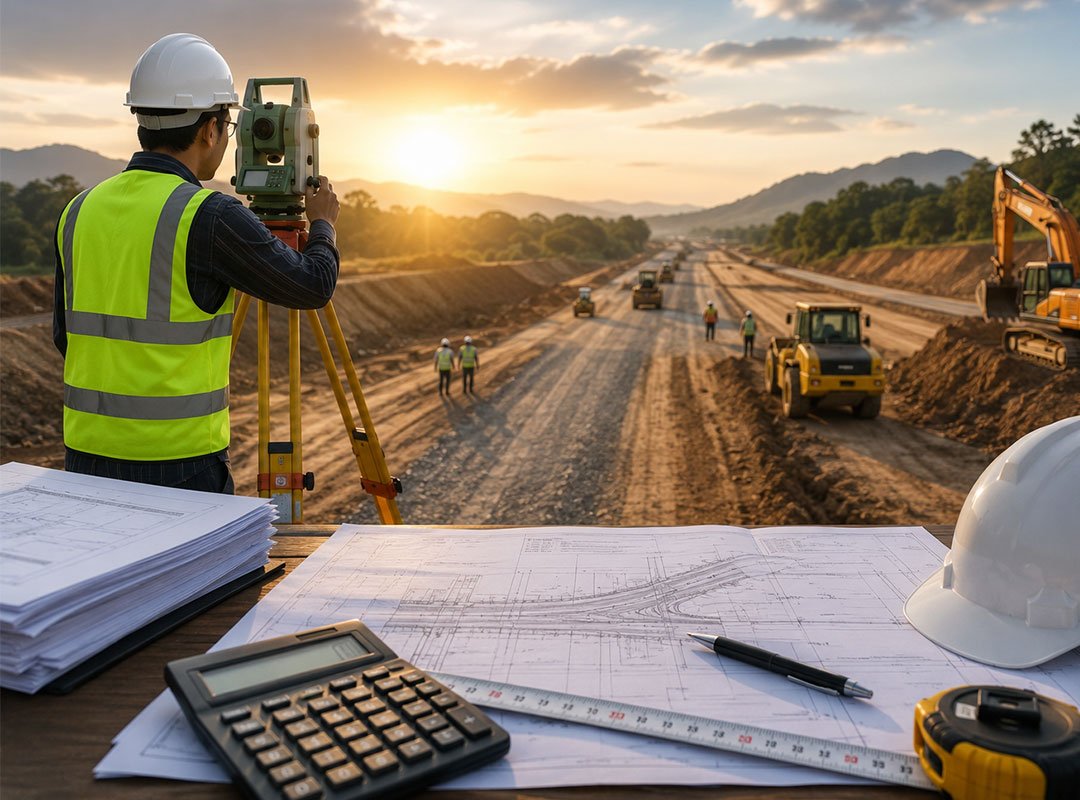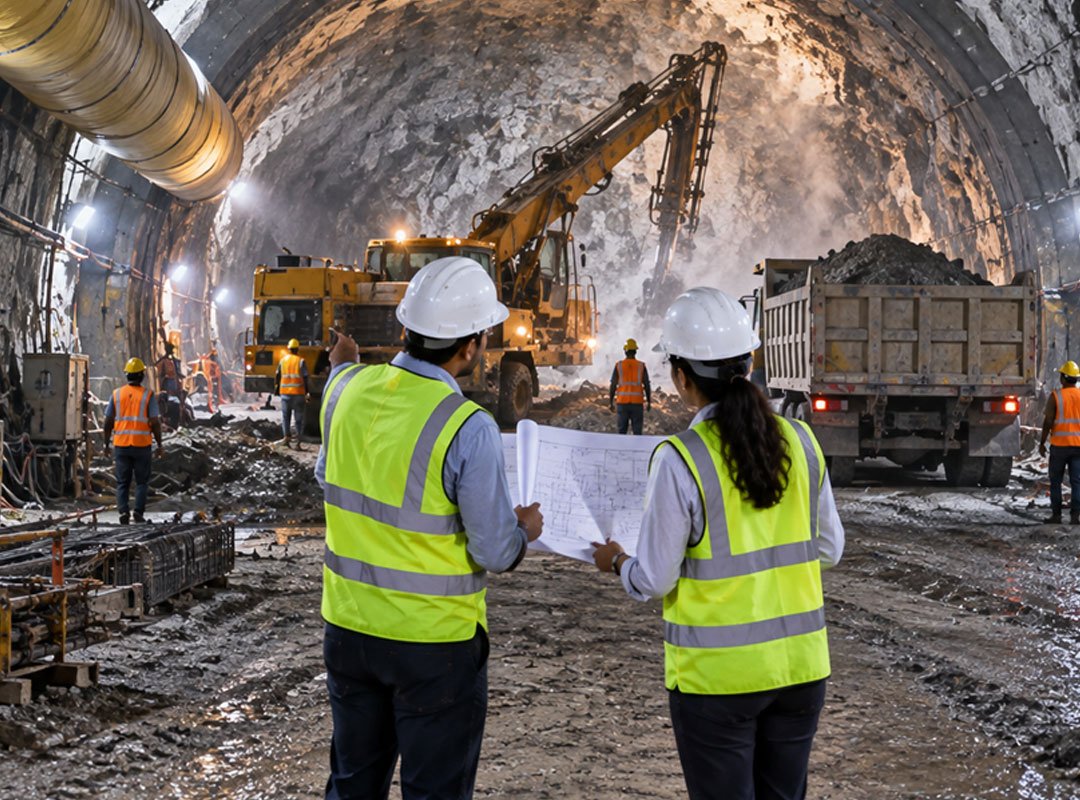
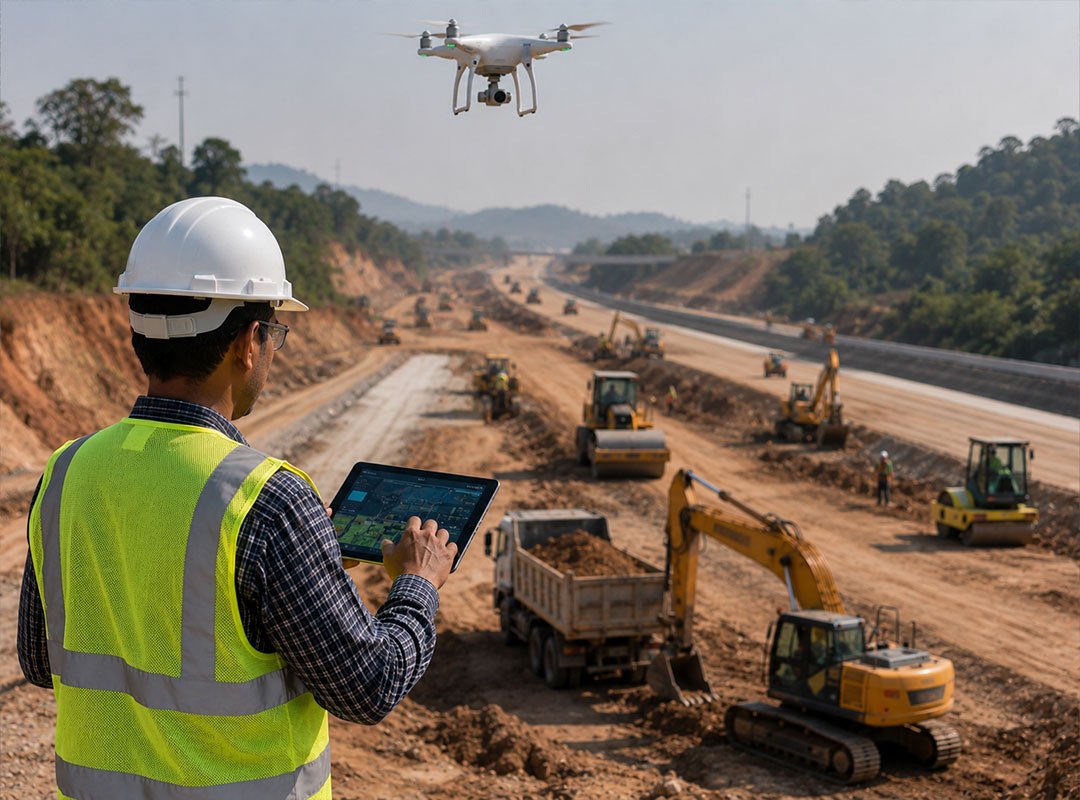
Digital transformation is redefining the global construction and infrastructure industry. What was once a sector driven primarily by manual planning, paper-based documentation, and conventional engineering practices is rapidly evolving into a technology-enabled ecosystem powered by real-time data, automation, artificial intelligence, cloud computing, and connected equipment. According to industry estimates, global investment in construction technology continues to grow as governments and infrastructure developers increasingly adopt digital solutions to improve productivity, transparency, and project delivery. In India, the government’s emphasis on Digital India, smart infrastructure, e-governance, and technology-led public procurement has accelerated this transition across the road construction sector.
For every Road Development Company in India, digitalisation is no longer limited to introducing modern equipment on construction sites. Technology now influences every stage of infrastructure development—from identifying project opportunities and preparing bids to planning, engineering, execution, monitoring, quality documentation, contract administration, and post-construction asset management. Digital tools help organisations make faster decisions, improve collaboration, reduce project risks, optimise resources, and maintain greater transparency throughout the project lifecycle.
As highway and road infrastructure projects continue to increase in complexity, clients increasingly expect contractors to deliver not only engineering expertise but also digital capabilities that enhance efficiency and accountability. Companies such as Pawan Highways India Pvt. Ltd. recognise that combining engineering excellence with technology-driven project execution enables better planning, improved productivity, and more reliable infrastructure delivery. The following developments demonstrate how digital technologies are transforming every Road Development Company in India and reshaping the future of highway infrastructure.
1. Digital Tendering Has Revolutionised Project Acquisition
The traditional tendering process has undergone a major transformation through digital procurement platforms. Today, a Road Development Company in India participates in government and public-sector tenders using electronic procurement systems that enable online document submission, digital signatures, secure bid evaluation, and transparent tender management. Platforms such as the Central Public Procurement Portal (CPPP), Government e-Marketplace (GeM), and various state e-procurement portals have significantly reduced paperwork, improved transparency, standardised bidding procedures, and accelerated procurement timelines. Digital tendering also enables companies to monitor opportunities across multiple states simultaneously, respond more efficiently to bid invitations, and maintain organised digital records for future reference and compliance.
2. GIS and Satellite Intelligence Are Improving Project Planning
Project planning now begins long before engineers arrive on site. Modern digital mapping technologies allow a Road Development Company in India to analyse terrain, topography, land use patterns, environmental constraints, drainage characteristics, and surrounding infrastructure using Geographic Information Systems (GIS) and high-resolution satellite imagery. These technologies support preliminary route assessments, corridor planning, land acquisition studies, environmental impact evaluations, and engineering feasibility assessments without requiring extensive physical surveys during the initial planning stages. By integrating spatial intelligence into decision-making, companies can identify potential constraints early, optimise project planning, reduce design revisions, and improve overall project preparedness.
3. Digital Twins Are Transforming Infrastructure Design
Digital twin technology is emerging as one of the most significant advancements in modern infrastructure engineering. A digital twin is a virtual representation of a physical asset that combines engineering models, operational data, construction information, and lifecycle performance into a single digital environment. An advanced Road Development Company in India can use digital twins to simulate construction sequences, evaluate alternative engineering solutions, identify potential design conflicts, and visualise project performance before physical construction begins. Throughout the infrastructure lifecycle, digital twins also support maintenance planning, asset monitoring, rehabilitation strategies, and long-term operational improvements, helping project owners make more informed infrastructure management decisions.
4. Connected Equipment Is Improving Fleet Productivity
Construction equipment has evolved from standalone machines into connected digital assets capable of continuously generating operational data. A modern Road Development Company in India increasingly relies on equipment telematics to monitor engine performance, fuel consumption, idle time, operating hours, machine location, maintenance schedules, and equipment utilisation in real time. This information enables project managers to optimise fleet deployment, reduce unnecessary fuel consumption, minimise equipment downtime, schedule preventive maintenance, and improve asset utilisation across multiple projects. Connected equipment not only enhances operational efficiency but also supports better financial planning by extending equipment life and reducing unexpected maintenance costs.
5. Cloud-Based Collaboration Is Transforming Project Communication
Large highway projects involve continuous collaboration between clients, consultants, designers, contractors, subcontractors, laboratories, and project management teams. Cloud-based collaboration platforms enable every authorised stakeholder to access updated drawings, engineering documents, inspection reports, design revisions, construction photographs, progress records, and contractual documentation from a single secure digital environment. For a Road Development Company in India, this significantly reduces communication delays, eliminates multiple versions of project documents, improves decision-making, and strengthens accountability across geographically dispersed teams. Cloud-based workflows also simplify document approvals, accelerate engineering reviews, and maintain complete digital records throughout the project lifecycle, creating greater transparency for both project owners and execution teams.
6. Digital Documentation Is Enhancing Quality Assurance and Compliance
Quality management has become increasingly digital, replacing traditional paper-based records with secure electronic documentation systems. Today, a progressive Road Development Company in India maintains digital inspection reports, laboratory test records, site photographs, material approvals, calibration certificates, and audit documentation through mobile applications and cloud-based quality management platforms. Digital documentation improves traceability, simplifies regulatory audits, reduces documentation errors, and enables project teams to retrieve historical quality records instantly whenever required. By maintaining structured digital evidence throughout construction, companies strengthen compliance while improving transparency for clients, consultants, and regulatory authorities.
7. Artificial Intelligence Is Enabling Predictive Project Management
Artificial Intelligence (AI) is gradually changing how infrastructure projects are planned and managed by shifting decision-making from reactive problem-solving to predictive analysis. A forward-looking Road Development Company in India can leverage AI-powered systems to analyse historical project data, identify productivity trends, forecast construction delays, estimate procurement requirements, evaluate equipment utilisation patterns, and anticipate cost variations before they affect project execution. AI algorithms can also assess weather forecasts, labour availability, and material consumption patterns to improve planning accuracy. Rather than replacing engineering expertise, Artificial Intelligence supports project teams by providing data-driven insights that improve scheduling, resource allocation, and strategic decision-making throughout the project lifecycle.
8. Smart Road Infrastructure Is Creating New Engineering Responsibilities
The evolution of intelligent transportation systems is expanding the responsibilities of every Road Development Company in India beyond conventional road construction. Modern highway infrastructure increasingly incorporates digital components such as traffic sensors, adaptive traffic signals, weigh-in-motion systems, electronic tolling infrastructure, intelligent lighting systems, variable message signs, CCTV surveillance, and integrated traffic management centres. These technologies improve traffic flow, enhance road safety, support real-time monitoring, and enable authorities to respond more effectively to congestion and emergency situations. As smart infrastructure becomes more common across India, road development companies must possess the technical capability to integrate civil engineering with intelligent transportation technologies while ensuring long-term operational reliability.
9. Data Analytics Is Becoming a Strategic Business Advantage
Every infrastructure project generates vast quantities of operational data covering productivity, costs, equipment performance, procurement, quality records, resource utilisation, project progress, and contractual milestones. Rather than storing this information only for reporting purposes, a progressive Road Development Company in India increasingly uses advanced analytics to improve business performance. Interactive dashboards and business intelligence platforms enable management teams to monitor key performance indicators, benchmark project performance, identify operational inefficiencies, evaluate productivity trends, and make informed strategic decisions across multiple projects. Data analytics also supports more accurate forecasting, continuous process improvement, and better organisational learning by transforming project information into actionable business intelligence.
10. Digital Transformation Is Shaping the Future of Road Development
Digital transformation is no longer a competitive advantage reserved for large multinational organisations—it is becoming a fundamental requirement for every Road Development Company in India seeking sustainable growth. Emerging technologies such as robotics, autonomous construction equipment, machine learning, advanced automation, computer vision, blockchain-enabled contract management, and next-generation digital engineering platforms are expected to reshape how road infrastructure is planned, executed, monitored, and maintained over the coming decade. Organisations that invest in digital capability today will be better positioned to improve operational efficiency, reduce project risks, strengthen client confidence, and adapt to the increasing technological expectations of government agencies and private infrastructure developers.
Digital technologies are fundamentally changing the way road infrastructure is conceived, designed, executed, and managed. From digital procurement and satellite-based planning to Artificial Intelligence, cloud collaboration, connected equipment, smart infrastructure, and advanced analytics, technology now influences every stage of the infrastructure lifecycle. For a modern Road Development Company in India, digital transformation is no longer limited to improving productivity—it has become an essential driver of transparency, operational efficiency, risk management, and long-term business competitiveness.
As India’s highway and transportation infrastructure continues to evolve, organisations that successfully combine engineering excellence with digital innovation will be best positioned to deliver complex infrastructure projects efficiently and responsibly. By embracing technology-driven project execution and continuously strengthening its engineering capabilities, Pawan Highways India Pvt. Ltd. remains committed to delivering high-quality road infrastructure solutions that meet the evolving needs of clients while supporting India’s vision for modern, connected, and future-ready transportation networks.