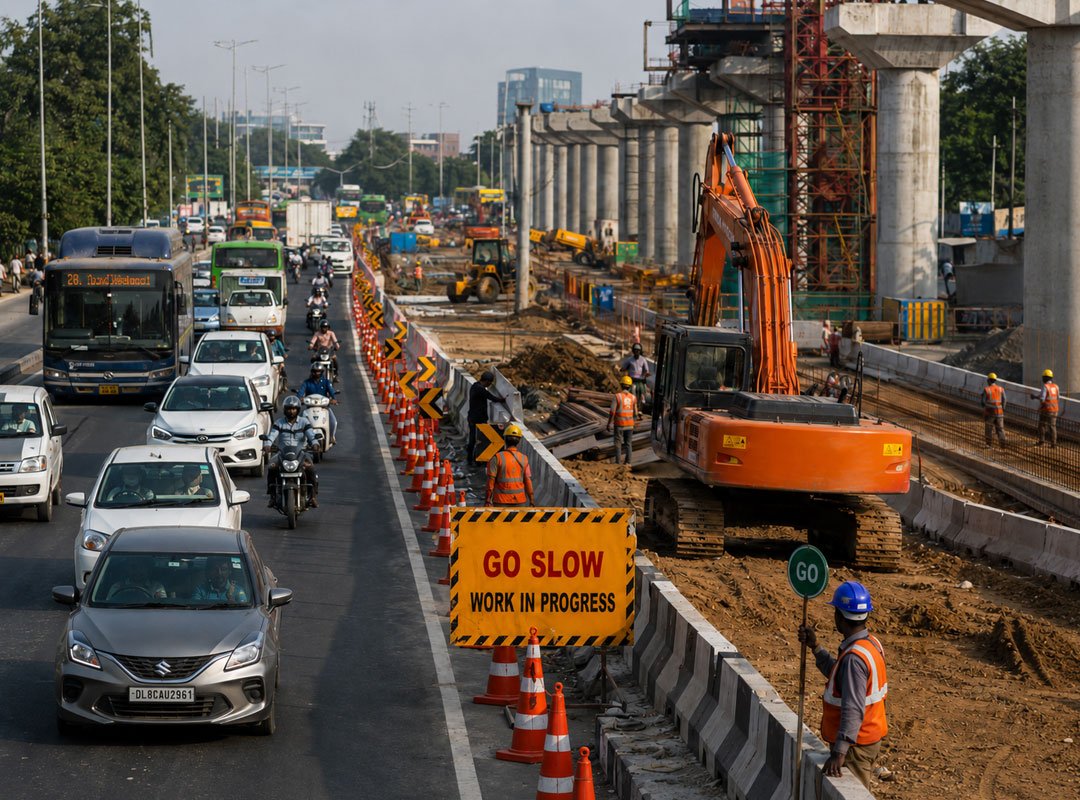
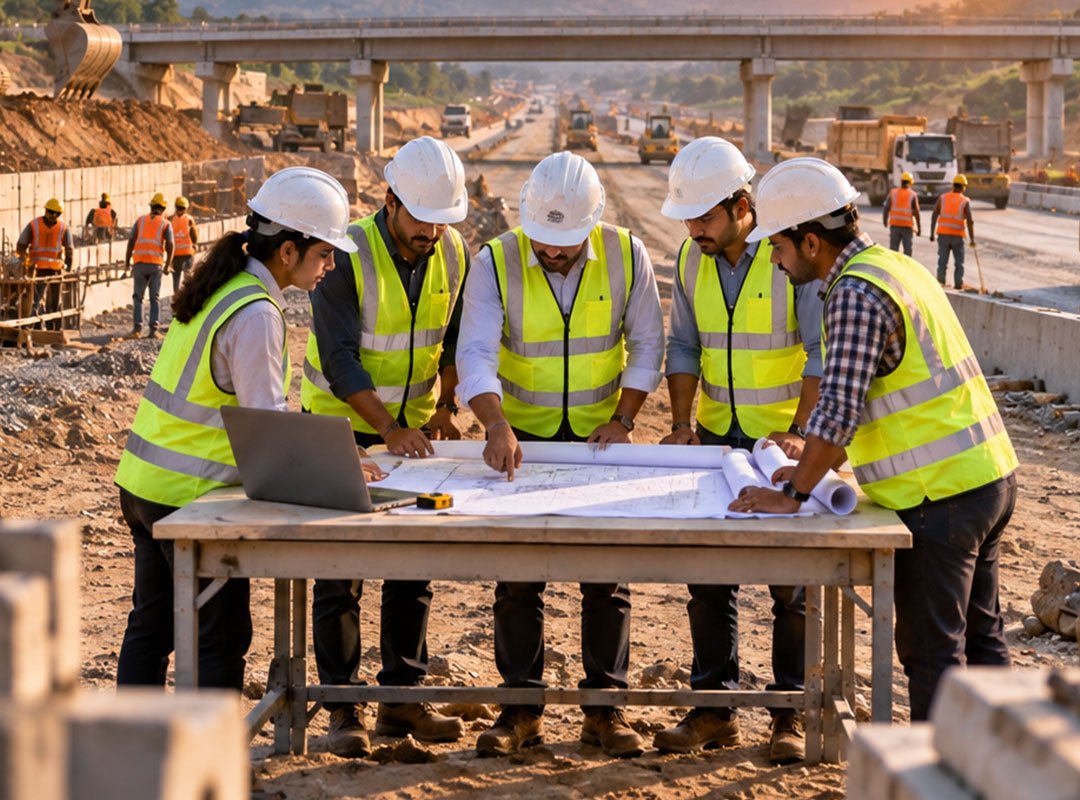
A highway project site is often imagined as a place dominated by excavators, paving equipment, survey instruments, engineers, and workers. That picture is incomplete. For a highway construction company in India, a project site is a temporary operating environment where technical, planning, safety, quality, commercial, administrative, environmental, and support teams work together.
The Periodic Labour Force Survey 2025 shows that construction accounted for 12.0% of workers in India under usual status. The Ministry of Labour and Employment has also reported about 5.73 crore Building and Other Construction workers registered across States and Union Territories. These figures cover construction as a whole, not highways alone, but they demonstrate the scale of the workforce involved in the wider sector.
Pawan Highways India Pvt. Ltd. (PHIPL), with more than three decades of hands-on infrastructure execution experience, operates within this demanding environment. The company’s work across highway, road, structural, and civil infrastructure reflects a reality that is easy to miss from outside the industry: successful project delivery requires many roles beyond engineering.
1. The Day Begins With Coordination, Not Construction
Work does not begin simply when machinery starts. Teams first review progress, planned activities, manpower, equipment availability, pending inspections, safety requirements, access conditions, and priorities for the day. Because several work fronts can operate at once, information must move quickly between field teams and the site office. Planning staff translate the project programme into daily activities, while supervisors communicate requirements to execution teams. For a highway construction company in India, this early coordination helps prevent one delayed activity from unnecessarily affecting another and creates a shared operating plan before physical work begins.
2. The Site Office Is a Working Control Centre
The site office handles a major part of the project’s operational workload. Progress reports, drawings, inspection requests, measurements, correspondence, approvals, photographs, material records, equipment details, and other documents are reviewed and maintained there. Document control creates a traceable record of what was instructed, inspected, measured, or approved. For PHIPL, this discipline supports the connection between decisions made in the site office and activities carried out in the field, particularly where compliance and project reporting must be maintained throughout execution.
3. Planning Teams Turn the Programme Into Daily Work
Highway projects are executed through linked activities rather than isolated tasks. Planning teams compare planned and actual progress, update schedules, identify upcoming requirements, and coordinate information from different departments. This is especially important on a highway project site, where earthwork, structures, drainage, pavement works, utilities, and other activities may progress at different locations. For a highway construction company in India, planning provides the framework that keeps these work fronts aligned and makes emerging constraints visible early.
4. Safety Personnel Influence the Entire Site Routine
Safety affects how work is organised throughout the day, not only during induction. Highway project requirements include occupational health and safety plans, emergency response arrangements, toolbox talks, worker training, personal protective equipment, first-aid provisions, and arrangements for transporting injured or sick workers to medical facilities. NHAI’s 2023-24 Annual Report records safety audits on 42,072 km of National Highways during the financial year, illustrating the scale of formal safety oversight in the sector. For a highway construction company in India, safety is therefore part of ordinary project management rather than a separate activity performed only during inspections.
5. Quality Work Extends Beyond Laboratory Testing
Quality control involves testing, inspections, records, and verification. Laboratory personnel conduct specified tests and maintain results, while field and quality teams inspect work before it moves to the next stage. They also verify whether execution conforms to approved drawings, specifications, and inspection requirements. MoRTH specifications provide for field laboratories and, where required, additional or confirmatory testing through accredited laboratories. At PHIPL, structured quality control forms part of the wider requirement to deliver infrastructure according to defined technical and compliance standards.
6. Survey and Data Teams Keep Physical Work Aligned
Survey teams establish and verify positions, levels, dimensions, and reference points used by construction crews. Their work connects design information with physical execution. Modern projects can also use GNSS equipment, digital survey systems, machine guidance, drones, and geographic information systems, making reliable data increasingly important. A positional error discovered late can affect quantities, drainage, structures, interfaces, or subsequent work. For a highway construction company in India, surveying is therefore a continuous field function rather than a one-time measurement exercise.
7. Commercial and Contract Teams Maintain Project Accountability
Physical progress creates commercial records. Quantities must be measured, checked, and linked to contractual provisions, while variations, bills, correspondence, notices, subcontract records, and supporting documents need to be maintained. Work may be completed physically, but certification and payment depend on proper records. Commercial teams therefore provide the link between construction progress and contractual administration. For a highway construction company in India, this function helps maintain clarity between what has been executed, what has been measured, and what is contractually recognised.
8. Administration and Welfare Keep the Site Functional
Highway projects can operate far from established urban services, making administration part of day-to-day continuity. Accommodation, transport, attendance, site facilities, camp administration, access arrangements, and other support services require coordination. Government requirements for construction projects also address worker welfare, medical facilities, first aid, and emergency arrangements. These functions may remain invisible to people outside the site, yet they directly affect the workforce’s ability to operate consistently. For a highway construction company in India, managing these practical conditions is part of maintaining an effective project environment.
9. Environmental and Community Interfaces Extend Beyond the Work Zone
The responsibilities of a project do not end at the edge of the construction area. Environmental and social management can involve waste handling, dust and noise controls, water management, camp conditions, worker facilities, and interaction with nearby communities. Road projects operating under formal environmental and social management frameworks may also use grievance redress mechanisms for community concerns. Construction can alter access, traffic movement, noise conditions, or local movement patterns, so these interfaces require organised management. For PHIPL, infrastructure execution therefore exists within a wider environment that includes people and activities beyond the immediate work front.
10. Security and Access Control Protect Site Continuity
A project site contains equipment, fuel, construction materials, tools, documents, temporary facilities, and multiple categories of personnel. Security teams manage entry and exit, visitor access, authorised movement, and protection of project assets. On a dispersed project, where several work fronts may operate simultaneously, access control also supports site discipline and emergency response. These functions are not part of engineering execution, but they protect the resources required for a highway construction company in India to maintain continuous operations.
11. Site Life Is Shaped by Weather, Distance and Working Conditions
A project site is different from a conventional office. Teams may work outdoors, move between dispersed locations, and operate under changing heat, rain, dust, visibility, and ground conditions. Such factors can influence work sequencing, travel, equipment movement, and daily safety arrangements. On a highway construction project in India, distance itself becomes an operational factor because teams and resources may be spread across a long corridor. A highway construction company in India has to account for these conditions through practical scheduling, resource movement, and field coordination.
12. Communication Connects Separate Functions
An engineer in the field, a planner in the site office, a laboratory technician, a safety officer, a commercial executive, and a project manager may be working on different aspects of the same activity. Their information becomes useful only when it reaches the right person at the right time. A test result can affect execution, a survey observation can require correction, a safety finding can change the work sequence, and a delay can trigger a planning revision. For a highway construction company in India, communication is therefore an operating mechanism that connects otherwise separate functions.
13. Much of Site Work Is Routine, Discipline and Record-Keeping
Project life is not a continuous sequence of major engineering decisions. A significant part consists of routine activities performed correctly and repeatedly: inspections, equipment checks, measurements, attendance records, safety briefings, progress updates, document filing, and closure of observations. These activities may not appear in photographs of a completed road, but they create the discipline needed to keep a project traceable and controlled. For PHIPL, this operational discipline works alongside technical capability, modern equipment, planning, quality systems, and project management in supporting infrastructure execution.
14. Why the Full Site Team Matters
A highway is built through engineering, but a project is delivered through a much wider team. Engineers supervise technical execution, planners organise time, survey teams establish physical references, quality teams verify compliance, safety personnel manage workplace risks, commercial teams maintain contractual records, administrators support the workforce, and environmental and social teams manage external interfaces. PHIPL’s work as a highway and infrastructure execution company reflects this broader project environment, where highway, structural, and civil infrastructure assignments depend on coordinated delivery across multiple functions. For a highway construction company in India, capability is therefore expressed not only through engineering knowledge but also through the ability to bring different teams and processes together.
The visible part of a highway project is pavement, structures, machinery, and field work. Behind it sits a less visible operating system made up of planning, safety, quality, surveying, documentation, commercial control, administration, welfare, environmental management, security, and communication.
Life at a project site is therefore broader than engineering alone. Every report prepared, inspection completed, measurement recorded, safety procedure followed, facility maintained, and field team supported contributes to project delivery. At Pawan Highways India Pvt. Ltd. (PHIPL), this wider understanding of project operations is reflected in the company’s focus on technical capability, disciplined execution, compliance, and coordinated infrastructure delivery. For a highway construction company in India, the finished road is the visible outcome. The people, systems, coordination, and discipline operating behind it are what make that outcome possible.