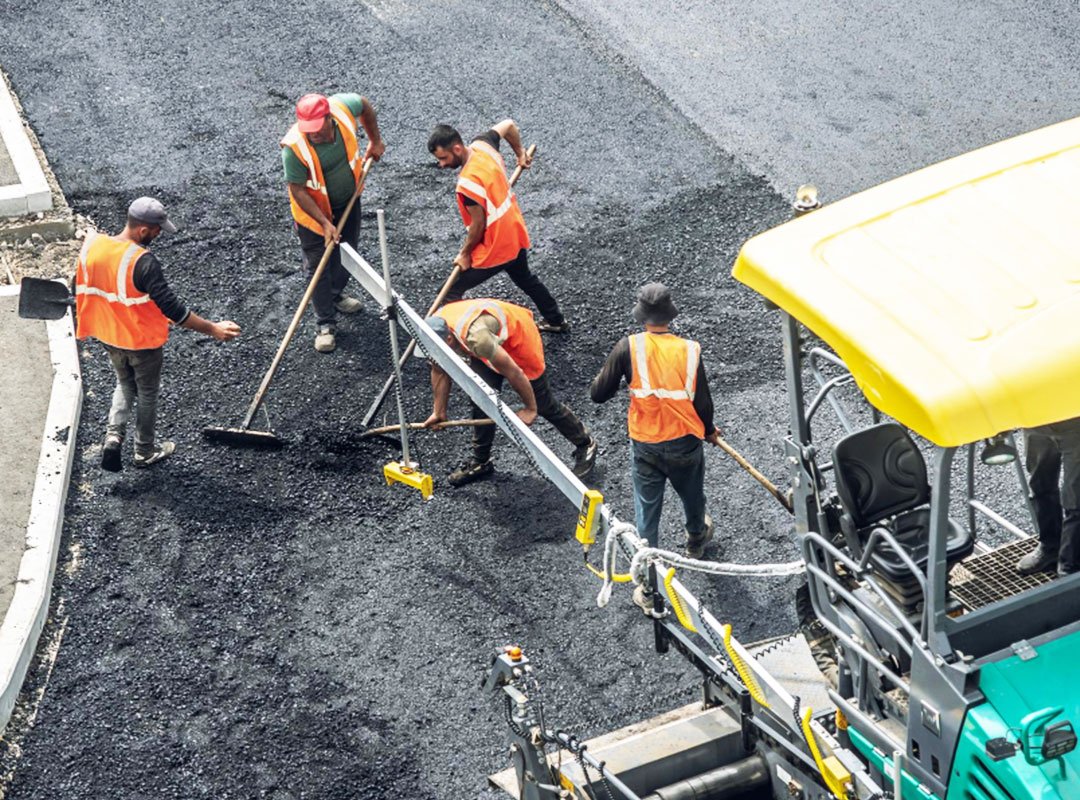

Highway quality depends not only on the materials used but also on the precision with which they are placed. A road paver is one of the most important machines in road construction, responsible for laying asphalt or concrete uniformly at the required thickness, width, grade, and cross slope before compaction. Any inconsistency during paving can result in segregation, uneven layer thickness, poor compaction, reduced ride quality, and premature pavement failures.
Modern highway projects are built to stringent quality standards, making the selection of paving equipment a critical engineering decision. There is no single road paver suitable for every application. A machine designed for constructing a six-lane expressway differs significantly from one used for municipal roads, airport pavements, or highway rehabilitation. Factors such as project size, pavement width, production targets, site conditions, and pavement type all influence equipment selection. Choosing the right paver improves construction efficiency, surface quality, and the long-term performance of the pavement.
Why Choosing the Right Road Paver Matters
A road paver establishes the geometry of the pavement before compaction begins. It controls layer thickness, longitudinal profile, cross slope, and surface texture, all of which directly influence pavement durability and riding comfort. Defects introduced during paving, such as uneven thickness or material segregation, cannot be completely corrected during rolling, making the paving process one of the most quality-sensitive stages of highway construction.
The selected paver also affects productivity and project economics. High-capacity machines enable continuous paving with fewer construction joints, while smaller pavers are better suited to urban projects where mobility is essential. Modern sensor-controlled pavers further improve paving accuracy by maintaining consistent screed levels and material flow, helping contractors meet MoRTH and IRC requirements for surface regularity and ride quality.
Types of Road Pavers
1. Crawler (Tracked) Asphalt Pavers
Crawler pavers are the preferred choice for large-scale highway construction because of their superior stability and traction. Operating on continuous rubber tracks, they distribute machine weight over a larger area, allowing them to work efficiently on granular sub-bases, weak foundations, and freshly prepared pavement layers without excessive ground pressure. Their stable movement helps maintain a constant paving speed, resulting in improved surface smoothness and uniform layer thickness.
These machines support wide screeds and high production capacities, making them ideal for expressways, national highways, airport runways, and other large infrastructure projects. Although crawler pavers involve higher transportation and maintenance costs due to their size and tracked undercarriage, they remain the industry standard for projects where paving quality, productivity, and long continuous stretches are priorities.
2. Wheeled Asphalt Pavers
Wheeled asphalt pavers are designed for projects requiring high mobility and easy manoeuvrability. Mounted on pneumatic tyres, they can travel faster between work locations and efficiently navigate intersections, roundabouts, and confined urban construction sites. This makes them well suited for municipal roads, industrial areas, road rehabilitation, parking facilities, and maintenance works involving multiple short paving sections.
While wheeled pavers reduce relocation time and improve operational flexibility, they provide lower traction than tracked machines on loose or freshly prepared surfaces. As a result, they are generally preferred for medium-scale and urban projects rather than high-production highway construction where greater stability is required.
3. Fixed Screed Pavers
The screed determines the final width, thickness, and surface profile of the asphalt layer. Fixed screed pavers use a rigid screed with a constant paving width, providing greater structural stability and minimizing screed deflection during operation. This results in highly consistent pavement levels and improved longitudinal smoothness.
Fixed screeds are best suited for projects with uniform lane widths, including expressways, airport runways, and newly constructed national highways. Their rigid construction also enables higher pre-compaction of asphalt, reducing the number of roller passes required to achieve the specified density. However, because the paving width cannot be adjusted during operation, they are less suitable for projects involving lane widening or changing road geometries.
4. Extendable Screed Pavers
Extendable screed pavers allow contractors to adjust paving width hydraulically without replacing the screed. This flexibility makes them suitable for highway widening, shoulders, service roads, interchanges, and other projects where pavement widths vary. Hydraulic adjustments reduce downtime and improve productivity by enabling the same machine to accommodate different lane configurations.
Although extendable screeds provide slightly lower rigidity than fixed screeds at their maximum width, they offer significant operational advantages on projects with changing road geometries. Their versatility makes them one of the most widely used paving solutions for rehabilitation and expansion projects.
5. Highway-Class Large Pavers
Highway-class pavers are engineered for high-volume asphalt paving on major infrastructure projects. Equipped with large hoppers, heavy-duty conveyors, powerful augers, and wide screeds, they maintain a continuous and uniform flow of asphalt mix, allowing uninterrupted paving over long distances. Their high production capacity reduces construction joints and improves overall pavement smoothness.
These machines are commonly used for expressways, national highways, airport runways, and industrial corridors where maintaining construction speed without compromising quality is essential. They are often paired with Material Transfer Vehicles (MTVs) to ensure a continuous asphalt supply and minimize thermal segregation, resulting in more consistent pavement density and durability.
6. Compact Asphalt Pavers
Compact pavers are specifically designed for projects where space limitations prevent the use of large paving equipment. They are widely used for bridge decks, service lanes, residential streets, cycle tracks, footpaths, parking areas, and utility restoration works where manoeuvrability is critical.
Despite their smaller size, compact pavers deliver accurate asphalt placement and high-quality surface finishes. Their lower operating weight, fuel consumption, and transportation costs make them an economical solution for smaller projects. However, their limited hopper capacity and production rate make them unsuitable for large highway construction requiring continuous high-volume paving.
7. Sensor-Controlled Smart Pavers
Modern road construction increasingly relies on sensor-controlled pavers that automatically regulate screed elevation, paving thickness, and cross slope using advanced sensors and GPS-based grade control systems. These machines continuously adjust the screed during operation, reducing operator dependency and ensuring consistent pavement geometry.
Smart pavers significantly improve longitudinal smoothness, layer thickness accuracy, and density uniformity while reducing the need for corrective work. Many models also incorporate telematics for monitoring productivity, fuel consumption, and machine performance, making them a preferred choice for premium highways, expressways, and other projects with stringent quality requirements.
8. Concrete Slipform Pavers
Concrete slipform pavers are specialized machines used for constructing rigid concrete pavements. Unlike asphalt pavers, they continuously place, vibrate, consolidate, and finish concrete without requiring fixed side forms, enabling faster construction with excellent dimensional accuracy.
Slipform pavers are extensively used for cement concrete highways, airport runways, industrial pavements, and freight corridors where high structural strength and long service life are required. Their ability to produce consistent slab thickness, alignment, and surface finish makes them indispensable for large-scale concrete pavement projects.
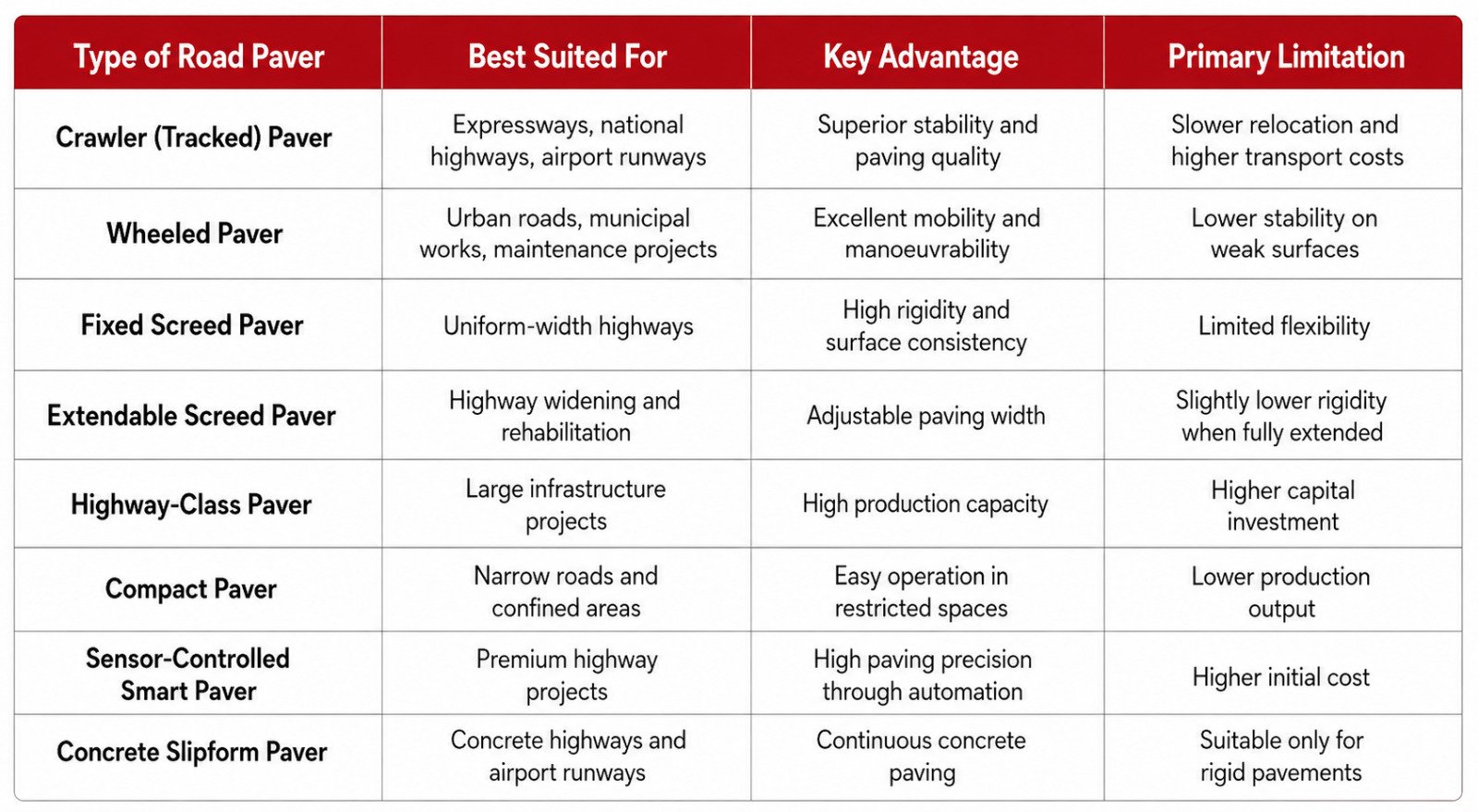
Comparison of Different Road Pavers for Highway Applications
Key Factors to Consider When Choosing the Right Road Paver
1. Project Scale and Production Requirements
The size of the project is the first factor to evaluate when selecting a road paver. Large infrastructure projects such as expressways and national highways require high-capacity crawler or highway-class pavers capable of maintaining continuous paving operations over long distances. In contrast, municipal roads, bridge approaches, and maintenance works benefit from compact or wheeled pavers that offer better mobility and lower operating costs. Matching the machine’s production capacity to project requirements improves efficiency while avoiding unnecessary equipment expenses.
2. Pavement Width and Road Geometry
Lane configuration determines the most suitable screed type. Fixed screed pavers are ideal for projects with consistent carriageway widths because they provide greater rigidity and smoother pavement finishes. However, projects involving highway widening, interchanges, service roads, or variable lane widths require extendable screeds that can adjust paving width without interrupting construction. Selecting the appropriate screed minimizes downtime and ensures consistent paving quality.
3. Pavement Type
The pavement material also influences equipment selection. Asphalt pavements constructed using Dense Bituminous Macadam (DBM), Bituminous Concrete (BC), or Stone Matrix Asphalt (SMA) require asphalt pavers capable of maintaining uniform material flow and layer thickness. On the other hand, rigid concrete pavements built using Pavement Quality Concrete (PQC) require slipform pavers designed for continuous concrete placement and finishing. Using the correct equipment for the pavement type improves construction quality and compliance with project specifications.
4. Ground Conditions and Site Accessibility
Ground conditions directly affect paving stability. Tracked pavers are better suited for granular sub-bases and weak foundations because their tracks distribute machine weight more evenly, reducing ground pressure. Wheeled pavers perform best on stable surfaces and urban environments where higher travel speeds improve productivity. Site constraints such as narrow streets, bridge decks, tunnels, or confined work zones may also require compact pavers that can operate efficiently within limited space.
5. Material Supply and Construction Continuity
Consistent asphalt supply is essential for achieving a uniform pavement surface. Interruptions caused by inadequate truck scheduling or asphalt plant delays can create cold joints, temperature variations, and material segregation, reducing pavement durability. High-production highway projects often use Material Transfer Vehicles (MTVs) to maintain a continuous flow of asphalt mix and improve paving consistency. Contractors should therefore consider plant capacity, haul distance, and site logistics when selecting paving equipment.
6. Surface Quality and Automation
Projects with stringent ride quality requirements benefit from pavers equipped with automatic grade and slope control systems. These technologies maintain consistent paving thickness and screed elevation throughout the operation, improving longitudinal smoothness and reducing the need for corrective work. Although automated pavers involve a higher initial investment, they help achieve better pavement quality, lower rework costs, and improved long-term performance.
Common Mistakes to Avoid When Selecting a Road Paver
Selecting a road paver based only on purchase price or machine size can significantly affect construction quality and productivity. Oversized pavers increase operating costs on small projects, while undersized machines struggle to meet production targets on large highway works. Choosing the wrong screed configuration may also lead to unnecessary adjustments and inconsistent pavement quality. Another common mistake is overlooking material supply logistics, as frequent interruptions during paving can result in cold joints and thermal segregation. Contractors should evaluate project specifications, pavement type, production requirements, and site conditions together rather than relying on a single selection criterion.
Road pavers play a decisive role in determining the quality, durability, and efficiency of highway construction. From maintaining the required pavement thickness and smoothness to ensuring uniform material placement, the right paver directly influences the long-term performance of the finished road. However, selecting the appropriate machine requires more than comparing equipment sizes or production capacities. Project scale, pavement type, lane configuration, site conditions, and quality requirements must all be considered before making a decision.
Each type of road paver serves a specific purpose. Crawler pavers deliver stability and high productivity for expressways and national highways, wheeled pavers provide the flexibility needed for urban projects, fixed and extendable screeds address different lane configurations, while compact, smart, and slipform pavers meet specialized construction requirements. Understanding these differences allows contractors to choose equipment that delivers the best balance of productivity, precision, and cost-effectiveness.
As India’s road infrastructure continues to expand through expressways, economic corridors, and highway modernization projects, the demand for advanced paving technology will continue to grow. Selecting the right road paver not only improves construction efficiency but also enhances pavement performance, reduces maintenance requirements, and contributes to the development of safer, longer-lasting, and more sustainable transportation infrastructure.