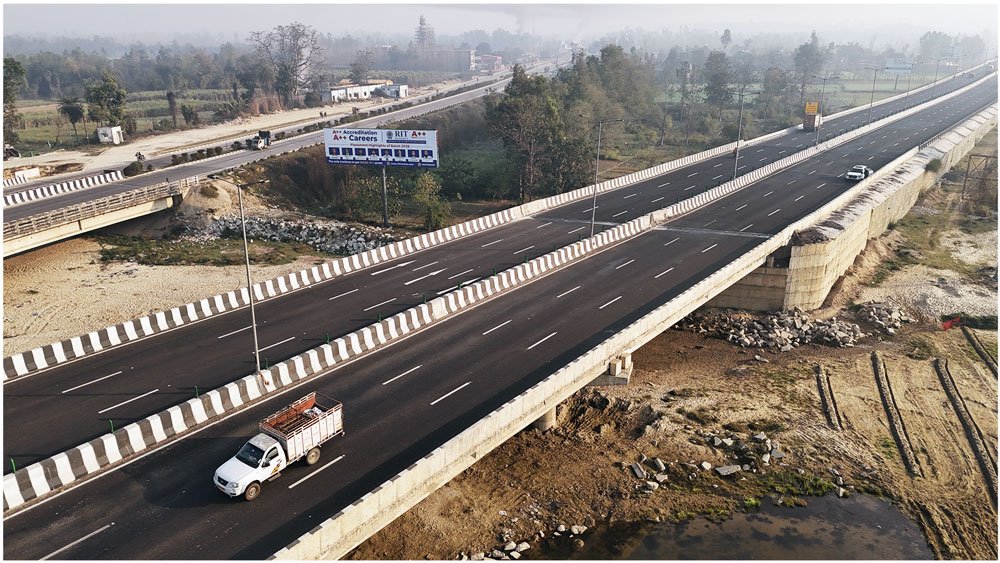
Public infrastructure is often viewed as a single construction activity, but every highway, urban road, bridge, footpath, and drainage network is created through multiple specialised construction services working together. A road project progresses through surveying, earthwork, drainage construction, pavement engineering, structural works, utility coordination, traffic safety installations, and quality verification before it is ready for public use.
Each service depends on the successful completion of the previous stage. Surveying establishes the project alignment, earthwork creates a stable foundation, drainage protects the pavement from water damage, structural works strengthen the network, while pavement construction distributes traffic loads across engineered layers. Although every service is carried out by specialised teams, none can function independently. This integrated approach enables experienced PWD contractor in India organisations to deliver infrastructure that meets quality, safety, and technical standards.
1. ACCURATE DATA SUPPORTS ACCURATE CONSTRUCTION
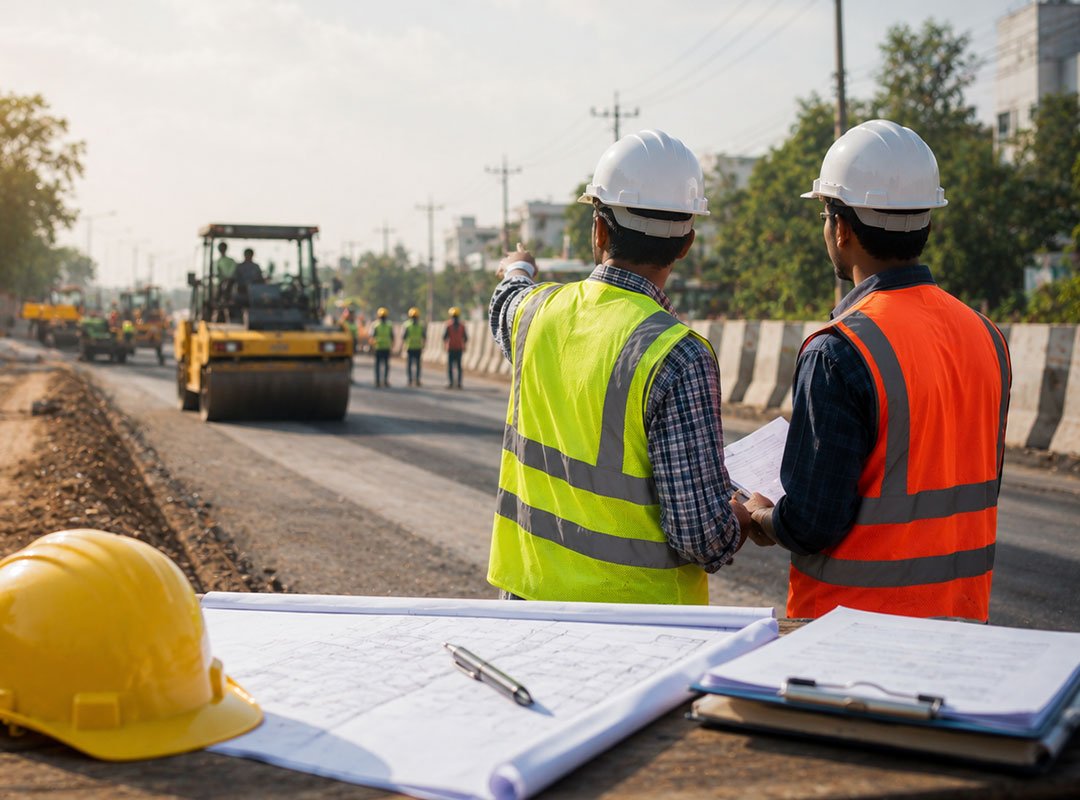
Every infrastructure project begins with detailed surveying because accurate measurements determine every stage of construction. Engineers establish road centre lines, benchmark levels, ground profiles, and project boundaries before work begins, ensuring construction follows approved designs.
Modern survey teams use Total Stations, GNSS receivers, Auto Levels, and GPS-based survey equipment to verify road geometry, embankment levels, drainage slopes, and structural locations with high precision. Survey control continues throughout construction because pavement layers, drainage structures, retaining walls, and bridges must all be built within approved horizontal and vertical tolerances.
Even minor surveying errors can affect drainage, alignment, and structural positioning, often leading to costly corrective work. For organisations providing road construction services in Delhi NCR, surveying forms the technical foundation for every construction activity that follows.
2. STRONG ROADS BEGIN BELOW THE SURFACE
The visible pavement represents only a small part of a highway’s engineering system. The long-term performance of any road depends largely on the strength of the prepared foundation beneath it.
Earthwork includes excavation, embankment construction, grading, soil stabilisation, filling, and compaction. Each layer is placed and compacted systematically to achieve the density required by engineering specifications, creating a stable platform for pavement construction.
The strength of the prepared subgrade is commonly assessed through the California Bearing Ratio (CBR) test, helping engineers determine whether the soil can safely support pavement loads or requires improvement. Highway embankments are also constructed in controlled layers, allowing every stage to achieve the specified compaction before the next layer is placed.
For every experienced PWD contractor in India, earthwork is a specialised construction service that directly influences pavement durability, ride quality, and long-term maintenance performance.
3. WATER MANAGEMENT IS CRITICAL TO ROAD PERFORMANCE
One of the leading engineering causes of premature pavement failure is inadequate drainage. Standing water and prolonged moisture infiltration weaken pavement layers, reduce the strength of supporting soils, and accelerate cracking, rutting, potholes, and surface failures.
To prevent these problems, road projects incorporate side drains, culverts, cross-drainage structures, stormwater channels, and slope drainage systems that quickly remove water from the pavement and surrounding areas. Effective drainage not only protects road structures from erosion and water damage but also improves driving safety by reducing surface water accumulation during rainfall.
As a result, drainage is not simply an additional feature. It is an essential construction service that significantly influences the durability, safety, and service life of public infrastructure.
4. EVERY LAYER HAS A SPECIFIC PURPOSE
A road is not built as a single layer of asphalt. Modern pavements consist of multiple engineered layers, each designed to distribute traffic loads and protect the overall road structure. The quality of every underlying layer directly influences the strength, durability, and performance of the finished pavement.
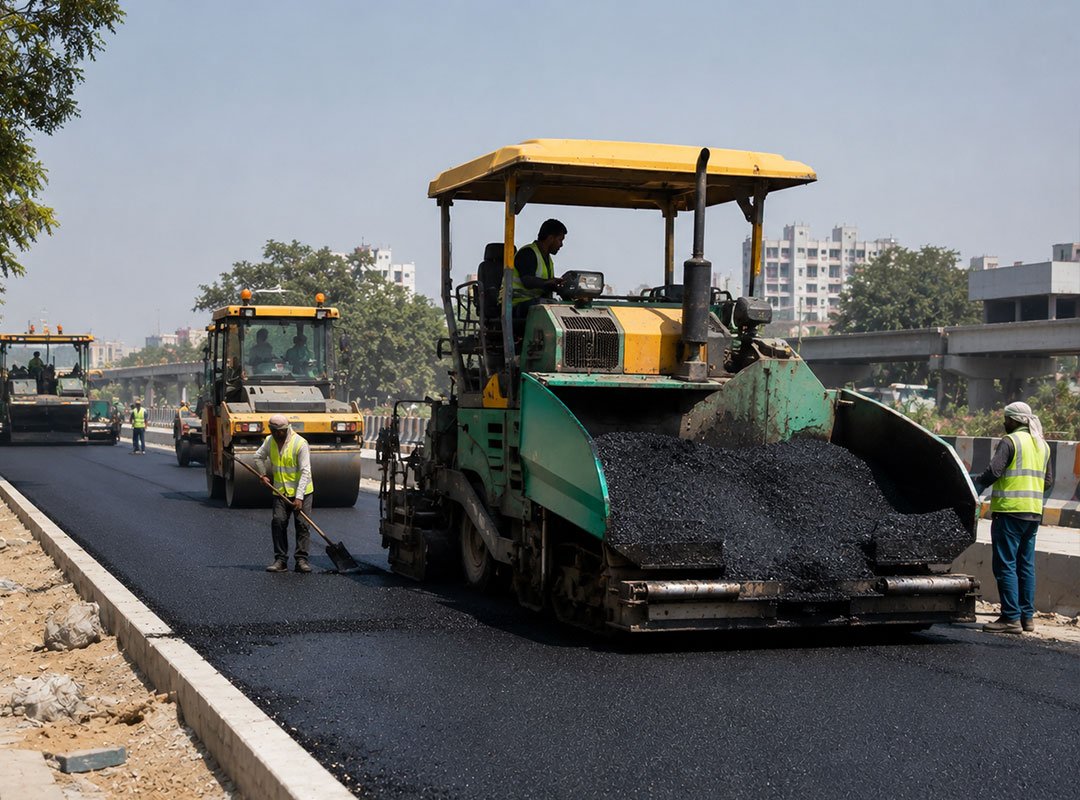
A typical flexible pavement consists of the prepared subgrade, Granular Sub-Base (GSB), Wet Mix Macadam (WMM), Dense Bituminous Macadam (DBM), and the Bituminous Concrete (BC) wearing course. The lower layers provide structural stability, while the upper bituminous layers improve riding quality, skid resistance, and resistance to weather.
Every layer is constructed to specified thickness tolerances because even small variations can reduce pavement life and structural capacity. Modern paving combines specialised machinery, engineering supervision, laboratory testing, and quality monitoring to ensure each layer satisfies project specifications before the next stage begins.
Bituminous paving is also a continuous operation where asphalt production, transportation, laying, and compaction must remain synchronised. Interruptions during paving can affect pavement joints and overall surface quality. For organisations delivering road construction services in Delhi NCR, maintaining this coordination is essential for achieving consistent pavement performance.
5. INFRASTRUCTURE MUST SERVE EVERY ROAD USER
Public infrastructure is designed for pedestrians as well as vehicles. As cities continue to expand, professionally designed pedestrian infrastructure has become an essential part of modern transportation planning.
Professional footpath construction services in India focus on improving accessibility, safety, and convenience while integrating seamlessly with surrounding roads. Modern footpaths increasingly follow universal accessibility principles, incorporating kerbs, tactile paving, ramps, pedestrian crossings, drainage provisions, and durable paving materials that improve mobility for children, senior citizens, and persons with disabilities.
Proper construction is equally important. Foundation preparation, level control, drainage integration, edge restraints, and suitable material selection help prevent settlement, loose paving blocks, and water accumulation, improving durability while reducing maintenance requirements.
6. SUPPORTING STRUCTURES IMPROVE STABILITY
Road infrastructure extends far beyond pavements. Culverts, box culverts, retaining walls, RCC drains, stormwater channels, slope protection works, and minor bridges enable roads to perform safely under varying terrain and weather conditions.
Each structure is designed according to site conditions, hydraulic requirements, traffic loads, and geotechnical characteristics. Proper foundation design, reinforcement detailing, concrete quality, and construction sequencing all contribute to long-term structural reliability.
For experienced PWD contractor in India organisations, these structures are integrated into overall project execution to create safe, durable, and resilient infrastructure.
7. MANAGING EXISTING INFRASTRUCTURE EFFICIENTLY
Many public infrastructure projects pass through developed areas where underground water pipelines, sewer lines, electrical cables, gas pipelines, and telecommunication networks already exist.
Before construction begins, these utilities often require identification and coordinated relocation in consultation with the respective authorities. Effective utility planning minimises service disruptions, protects existing assets, improves worker safety, and prevents avoidable construction delays, allowing specialised construction services to progress smoothly.
8. SAFE ROADS ARE PLANNED FROM THE BEGINNING
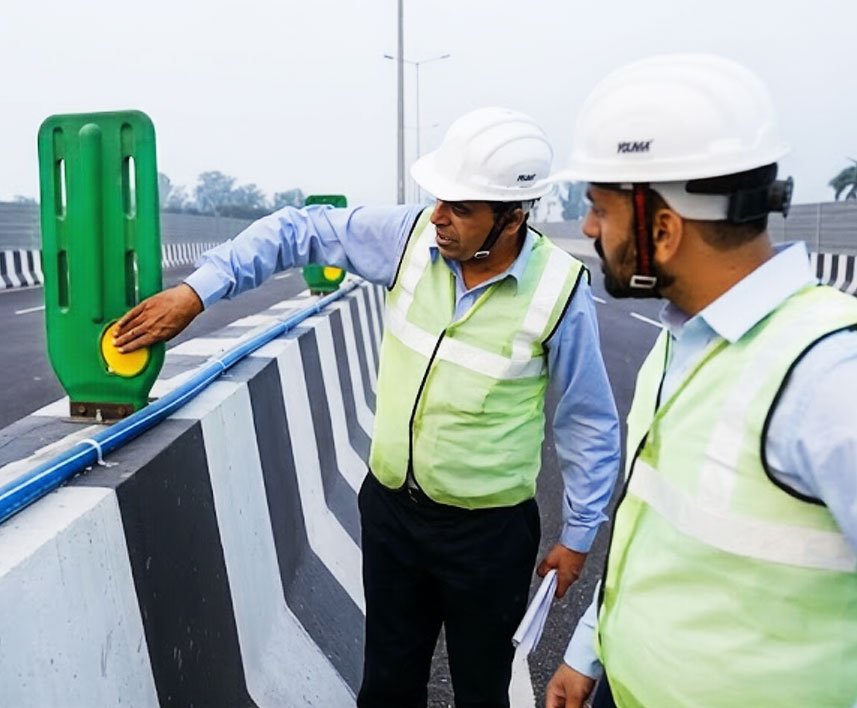
Traffic safety is incorporated during planning, design, and construction rather than being added after project completion. Road markings, reflective studs, traffic signage, crash barriers, guardrails, delineators, pedestrian crossings, and speed-calming measures are integrated to improve driver guidance, visibility, and overall road safety.
For providers of road construction services in Delhi NCR, delivering complete infrastructure means combining construction quality with well-planned traffic safety systems that protect both motorists and pedestrians from the day the road becomes operational.
9. EVERY SERVICE SUPPORTS THE NEXT
The success of a public infrastructure project depends on how effectively specialised construction services work together. Surveying establishes accurate project data, earthwork creates a stable foundation, drainage protects the pavement, structural works improve stability, utility coordination prevents service disruptions, and traffic safety measures prepare the road for public use. When these services are properly coordinated, projects progress efficiently while maintaining quality, safety, and technical compliance.
A weakness in any one activity can affect the overall performance of the completed infrastructure. Inadequate drainage can shorten pavement life, inaccurate surveying may alter road geometry, poor compaction can reduce structural stability, and delayed utility relocation can interrupt construction schedules. This is why experienced PWD contractor in India organisations treat every construction service as part of one integrated execution process.
10. EVERY DISCIPLINE HAS A SHARED RESPONSIBILITY
Large public infrastructure projects require the coordinated efforts of multidisciplinary teams, including civil engineers, survey professionals, structural engineers, quality specialists, safety officers, laboratory technicians, equipment operators, procurement teams, and project managers.
Successful execution also depends on close coordination with consultants, utility agencies, government authorities, and clients. This collaborative approach improves planning, strengthens technical compliance, reduces delays, and ensures every construction service contributes towards the successful delivery of durable public infrastructure.
For organisations providing road construction services in Delhi NCR, effective coordination is essential for maintaining project schedules while achieving consistent engineering quality.
11. QUALITY CONSTRUCTION DELIVERS LONG-TERM VALUE
Public infrastructure is expected to perform reliably for decades. Roads, footpaths, drainage systems, and supporting structures achieve longer service life when every construction activity is executed according to engineering specifications and quality standards.
Accurate surveying, well-compacted foundations, effective drainage, durable pavement construction, and properly designed pedestrian infrastructure all contribute to reducing maintenance requirements, minimising traffic disruptions, and improving lifecycle performance. The long-term value of infrastructure is therefore determined not by individual construction activities but by the quality of their integration.
12. PAWAN HIGHWAYS INDIA PVT. LTD. (PHIPL)’S INTEGRATED SERVICE APPROACH
At Pawan Highways India Pvt. Ltd. (PHIPL), infrastructure development is delivered through integrated engineering and construction services that combine technical expertise, specialised resources, modern equipment, quality assurance, and disciplined project execution. Every project is planned and executed through the coordinated delivery of surveying, earthwork, pavement construction, drainage systems, structural works, utility coordination, pedestrian infrastructure, and traffic safety solutions.
As an experienced PWD contractor in India, PHIPL follows systematic engineering supervision, quality control, laboratory testing, and proven construction methodologies to ensure every project complies with approved technical specifications while maintaining high standards of safety and execution.
With extensive experience in providing road construction services in Delhi NCR, the company manages every stage of construction through detailed planning, resource coordination, continuous monitoring, and disciplined project management. These capabilities enable multiple specialised construction services to operate together efficiently while supporting timely project completion and long-term infrastructure performance.
PHIPL also provides reliable footpath construction services in India, recognising that pedestrian infrastructure is an essential element of sustainable urban development. By incorporating universal accessibility principles, effective drainage, durable construction practices, and quality-controlled execution, the company develops pedestrian infrastructure that improves accessibility, safety, and usability for all users.
Rather than viewing infrastructure as a series of separate construction activities, PHIPL believes successful public assets are created when specialised construction services operate as one integrated system. This approach enables the company to deliver roads, highways, footpaths, drainage systems, and civil infrastructure that provide long-term value, strengthen public infrastructure, and support the evolving needs of communities across India.